| Transition Temperature | 12 K |
|---|---|
| Experiment Temperature | 1.5 K |
| Propagation Vector | k1 (0, 0, 0) |
| Parent Space Group | Cmmm (#65) |
| Magnetic Space Group | Cmm'm' (#65.486) |
| Magnetic Point Group | m'm'm (8.4.27) |
| Lattice Parameters | 5.12280 8.28490 3.96790 90.00 90.00 90.00 |
|---|---|
| DOI | 10.1016/j.jssc.2014.11.016 |
| Reference | Jinlei Yao, O. Isnard, A. V. Morozkin, T. I. Ivanova, Yu. S. Koshkid'ko, A. E. Bogdanov, S. A. Nikitin, W. Suski, Journal of Solid State Chemistry (2015) 222 123 - 128 |
| Label | Element | Mx | My | Mz | |M| |
|---|---|---|---|---|---|
| Nd1 | Nd | 0.0 | 2.37 | 0.0 | 2.37 |
Author's Accepted Manuscript
Magnetic order and crystal structure study of \( YNi_{4}Si \) -type \( NdNi_{4}Si \)
Jinlei Yao, O. Isnard, A.V. Morozkin, T.I. Ivanova, Yu. S. Koshkid'ko, A.E. Bogdanov, S.A. Nikitin, W. Suski

www.eslevier.com/locate/jssc
PII: S0022-4596(14)00495-2 DOI: http://dx.doi.org/10.1016/j.jssc.2014.11.016 Reference: YJSC18708
To appear in: Journal of Solid State Chemistry
Received date: 3 October 2014 Revised date: 11 November 2014 Accepted date: 16 November 2014
Cite this article as: Jinlei Yao, O. Isnard, A.V. Morozkin, T.I. Ivanov, Yu. S. Koshkid'ko, A.E. Bogdanov, S. A. Nikitin, W. Suski, Magnetic order and crystal structure study of \( YNi_{4}Si \) -type \( NdNi_{4}Si \) , Journal of Solid State Chemistry, http://dx.doi.org/10.1016/j.jssc.2014.11.
This is a PDF file of an unedited manuscript that has been accepted for publication. As a service to our customers we are providing this early version of the manuscript. The manuscript will undergo copyediting, typesetting, and review of the resulting galley proof before it is published in its final citable form. Please note that during the production process errors may be discovered which could affect the content, and all legal disclaimers that apply to the journal pertain.
Magnetic order and crystal structure study of YNi_{4}Si-type NdNi_{4}Si
Jinlei Yao \( ^{a} \) , O. Isnard \( ^{b,c} \) , A. V. Morozkin \( ^{d,*} \) , T.I. Ivanova \( ^{e} \) , Yu. S. Koshkid'ko \( ^{f,g} \) , A. E. Bogdanov \( ^{e} \) , S. A. Nikitin \( ^{e} \) , W. Suski \( ^{f,h} \)
\( ^{a} \) Research Center for Solid State Physics and Materials, School of Mathematics and Physics, Suzhou University of Science and Technology, Suzhou 215009, China
\( ^{b} \) Université Grenoble Alpes, Inst NEEL, BP166, Grenoble F-38042, France
\( ^{c} \) CNRS, Institut NEEL, 25 rue des martyrs, Grenoble F-38042, France
\( ^{d} \) Department of Chemistry, Moscow State University, Leninskie Gory, House 1, Building 3, Moscow, GSP-2, 119992, Russia
\( ^{e} \) Physics Department, Moscow State University, Moscow 119992, Russia
International Laboratory of High Magnetic Fields and Low Temperatures, Wroclaw, Poland
\( ^{g} \) VSB-Technical University of Ostrava, Ostrava-Poruba 70833, Czech Republic
\( ^{h} \) Polish Academy of Sciences, Trzebiatowski Institute of Low Temperatures and Structure Research, P.O. Box 1410, 50-950 Wroclaw 2, Poland
Abstract
Magnetic measurements and neutron powder diffraction investigation of the magnetic structure of the orthorhombic \( YNi_{4}Si \) -type (space group Cmmm) \( NdNi_{4}Si \) compound are presented. The magnetocaloric effect of \( NdNi_{4}Si \) is calculated in terms of the isothermal magnetic entropy change and it reaches the maximum value of -3.3 J/kg·K for a field change of 50 kOe near \( T_{C}=12 \) K. Below ~12 K, \( NdNi_{4}Si \) exhibits a commensurate b-axis collinear ferromagnetic ordering with the Cmm'm magnetic space group in a zero magnetic field. At 1.5 K, the neodymium atoms have the magnetic moment of 2.37(5) \( \mu_{B} \) . The orthorhombic crystal structure and its thermal evolution are discussed in comparison with the \( CaCu_{5} \) -type compound.
Keywords: Rare-earth compounds; Magnetic properties; Magnetocaloric effect; Neutron diffraction; Magnetic structure
\( ^{*} \) Corresponding author. E-mail address: morozkin@tech.chem.msu.ru (A.V. Morozkin).
1. Introduction
Recently, the orthorhombic derivative of the \( CaCu_{5} \) -type, namely the \( YNi_{4}Si \) -type (space group Cmmm), \( RNi_{4}Si \) compounds (R = Y, La, Ce, Sm, Gd - Ho) were reported [1]. These compounds supplement the known series of the \( CaCu_{5} \) -type \( RNi_{5} \) compounds and \( RNi_{4}Si \) solid solutions [2, 3]. The orthorhombic distortion of parent \( CaCu_{5} \) -type compounds may be considered a prospective route for optimizing their magnetic and hydrogen storage properties [4-6]. In order to test its feasibility, it requires a systematic investigation of the magnetic properties of \( YNi_{4}Si \) -type \( RNi_{4}Si \) , which can be in comparison with those of the well-known \( CaCu_{5} \) -type \( RNi_{5} \) and \( RNi_{4}Si \) compounds.
The early reports of the magnetic properties and structures of \( CaCu_{5} \) -type \( RNi_{5} \) are \( [7-11] \) and \( YNi_{4}Si \) -type \( RNi_{4}Si[1, 12, 13] \) (R = Gd, Tb, Dy) permit us to draw the following preliminary conclusions. In the case of \( \{Tb, Dy\}Ni_{4}Si \) the ferromagnetic ordering temperature increases from the \( CaCu_{5} \) -type \( RNi_{5} \) , across \( CaCu_{5} \) -type \( RNi_{4}Si \) to \( YNi_{4}Si \) -type \( RNi_{4}Si, \) whereas the Curie point decreases from \( GdNi_{5} \) to the \( CaCu_{5} \) -type \( GdNi_{4}Si \) and the Curie temperatures of \( CaCu_{5} \) -type and \( YNi_{4}Si \) -type \( GdNi_{4}Si \) are the same. We suggest that the transformation of their magnetic properties in the orthorhombic distortion of \( CaCu_{5} \) -type lattice results from the initial ab-plane ferromagnetic-like ordering of Tb and Dy sublattices and possible c-collinear ferromagnetic ordering of Gd sublattice. The Ni ions have little to no magnetic moments in these compounds.
The initial \( CaCu_{5} \) -type \( NdNi_{5} \) shows ferromagnetic ordering below 7.2 K with isothermal magnetic entropy change of -8.45 J/kg·K for a field change of 0-50 kOe [14, 15]. The substitution of Si for Ni in the \( NdNi_{4}Si \) solid solution leads to increasing of Curie point from 7.2 to 9.2 K and decreasing of isothermal magnetic entropy change from -8.45 J/kg·K to -7.3 J/kg·K for a field change of 0-50 kOe [16].
This work aims to understand the effects of orthorhombic distortion from the parent \( CaCu_{5} \) -type \( NdNi_{5} \) to the \( YNi_{4}Si \) -type \( NdNi_{4}Si \) compound through the magnetic measurements and neutron powder diffraction.
2. Material and methods
The \( NdNi_{4}Si \) sample was prepared by arc melting of the stoichiometric amounts of Nd (99.9 wt. %), Ni (99.95 wt. %) and Si (99.99 wt. %). The sample was annealed at 1070 K for 200 h in an argon-filled and sealed quartz tube and subsequently quenched in ice-cold water. The structure, purity and composition of the polycrystalline sample were evaluated using powder X-ray diffraction (XRD) and electron microprobe analysis. The XRD data were obtained on a Rigaku D/MAX-2500 diffractometer ( \( CuK_{\alpha1} \) radiation, \( 2\theta = 10 - 80 \) deg, step 0.02 deg, 1 s/step). An INCA-Energy-350 X-ray EDS spectrometer (Oxford Instruments) on the Jeol JSM-6480LV scanning electron microscope (20 kV accelerating voltage, beam current 0.7 nA and beam diameter 50 micron) was employed to perform the microprobe analyses of the sample. Signals from three points were averaged and estimated standard deviations were 1 at. % for Nd (measured by L-series lines), 1 at. % for Ni and 1 at. % for Si (measured by K-series lines).
DC magnetization of the polycrystalline \( NdNi_{4}Si \) sample was measured on a commercial Physical Property Measurement System (Quantum Design PPMS-DynaCool) in the temperatures range of 5 - 300 K with an applied magnetic field of 5 kOe in the zero-field-cooled (ZFC) and field-cooled (FC) modes. The isothermal saturation magnetization was measured for the magnetic field change from 0 to 50 kOe at various temperatures.
Neutron diffraction experiments were carried out at the high flux reactor of the Institut Laue Langevin (Grenoble, France). The data were collected in a zero magnetic field on the two-axis D1B powder diffractometer equipped with a 1300 cell curved detector spanning the \( 2\theta \) range of 130 deg. \( ^{[17]} \) . The temperature ranges were 128 K – 30 K with a step of \( \sim \) 10 K and 25 K – 1.5 K with a step of \( \sim \)
5 K. The neutron wavelength of 2.5238 Å was selected by the (002) reflection of a pyrolitic graphite monochromator and the \( 2\theta \) step was 0.1 deg.
3. Theory/calculation
The unit cell data were derived from the powder XRD using the Rietan program \( [18, 19] \) in the isotropic approximation at room temperature. The paramagnetic susceptibility was fitted to the Curie-Weiss law to obtain the effective magnetic moment and paramagnetic Curie temperature \( [20] \) . Magnetocaloric effect (MCE) was calculated in terms of the isothermal magnetic entropy change, \( \Delta S_{m} \) , using the magnetization vs. field data obtained near the magnetic transition and employing the thermodynamic Maxwell equations \( [21] \) . The neutron diffraction data were refined with the FULLPROF program \( [22] \) . The magnetic space groups \( [23, 24] \) were used for the analysis of neutron diffraction data.
4. Results
4.1. Crystal structure
Both the microprobe and X-ray powder analyses show that \( NdNi_{4}Si \) is a single-phase sample. The microprobe analysis yielded the \( Nd_{17(1)}Ni_{68(1)}Si_{15(1)} \) composition, and the X-ray powder analysis confirmed the \( YNi_{4}Si \) -type structure with the Cmmm space group. The lattice parameters were refined as \( a = 0.51354(2) \) nm, \( b = 0.83006(3) \) nm, \( c = 0.39707(2) \) nm, \( V = 0.16926(4) \) nm \( ^{3} \) , \( b/(3^{1/2}\cdot a) = 0.93320(3) \) , and the atomic sites \( \mathrm{Nd}(2a) \) [0, 0, 0], \( \mathrm{Ni}(4i) \) [0, 0.3424(5), 0], \( \mathrm{Ni}(4f) \) [1/4, 1/4, 1/2] and \( \mathrm{Si}(2c) \) [0, 1/2, 1/2] ( \( R_{F} = 4.5\% \) ). The atomic positions for the Nd 2a, Ni1 4i and Ni2 4f sites in the Cmmm space group with the corresponding symmetry operators are given in Table 1.
4.2. Magnetic properties and magnetocaloric effect
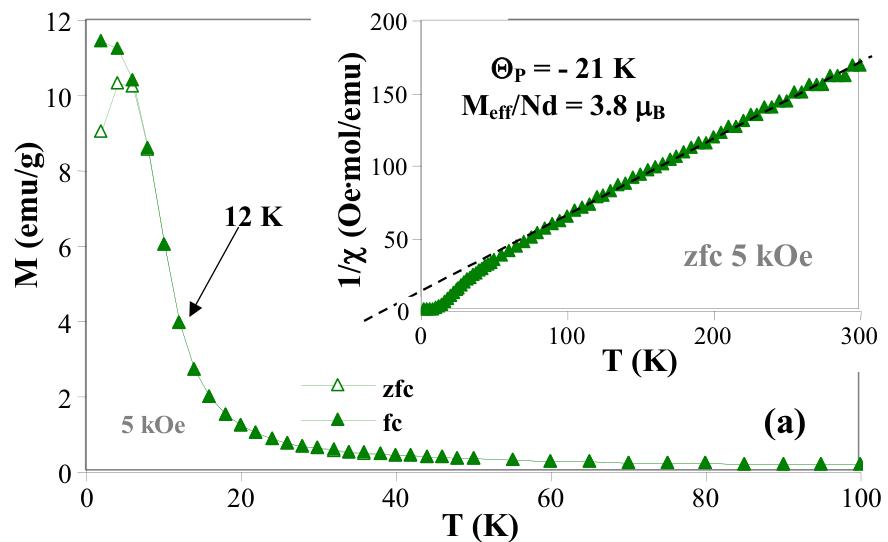
The zero-field-cooled (ZFC) and field-cooled (FC) magnetization data recorded during heating in 5 kOe are shown in Fig. 1a. The FC data are indicative of a typical ferromagnet, while the ZFC data suggest presence of weak competing antiferromagnetic interactions, which can be easily overcome in
small magnetic fields. The paramagnetic susceptibility of \( NdNi_{4}Si \) follows the Curie-Weiss law in the temperature range 90-300 K (inset in Fig. 1a). The fit to the Curie-Weiss law yielded a paramagnetic Weiss temperatures \( \Theta_{p} = -21(5) \) K and the effective moment per formula unit \( M_{eff} = 3.8 \mu_{B}/f.u. \) The negative \( \Theta_{p} \) can be seen as the development of antiferromagnetic-type interactions, which is also observed in the ferromagnetic \( SmNi_{4}Si \) compound [25]. The refined \( M_{eff} \) is close to the theoretical magnetic moment of \( Nd^{3+} \) (3.62 \( \mu_{B} \) ) [26], indicating Nd is trivalent in the compound. However the neutron diffraction studies do not confirm the presence of magnetic moments on Ni, and thus only Nd atoms are assumed to carry localized magnetic moments. In this case, the effective magnetic moment of the Nd atoms is 3.8 \( \mu_{B} \) , and a slight increase of \( \sim0.2 \mu_{B} \) over the theoretical value can be attributed to the polarization of conduction electrons, predominantly the Nd 5d ones, through the 4f-5d exchange interactions.
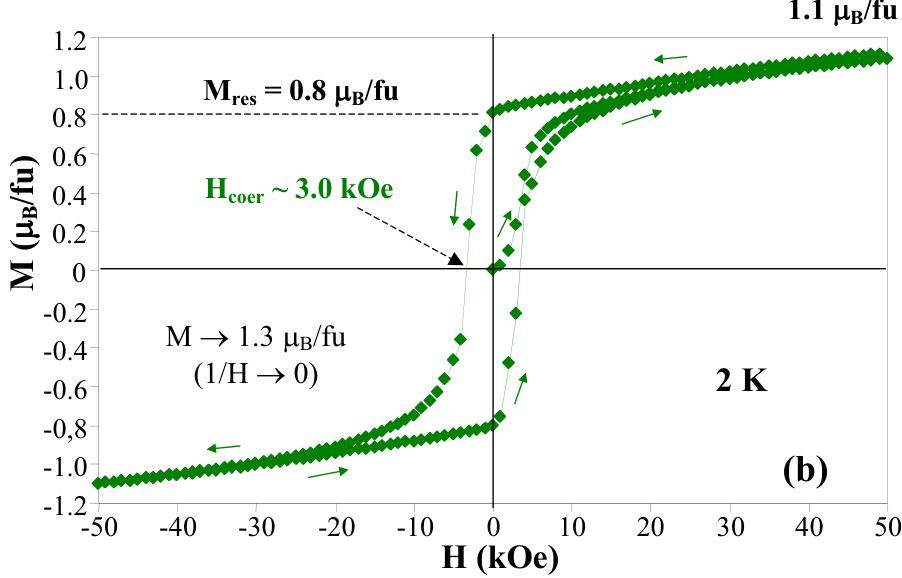
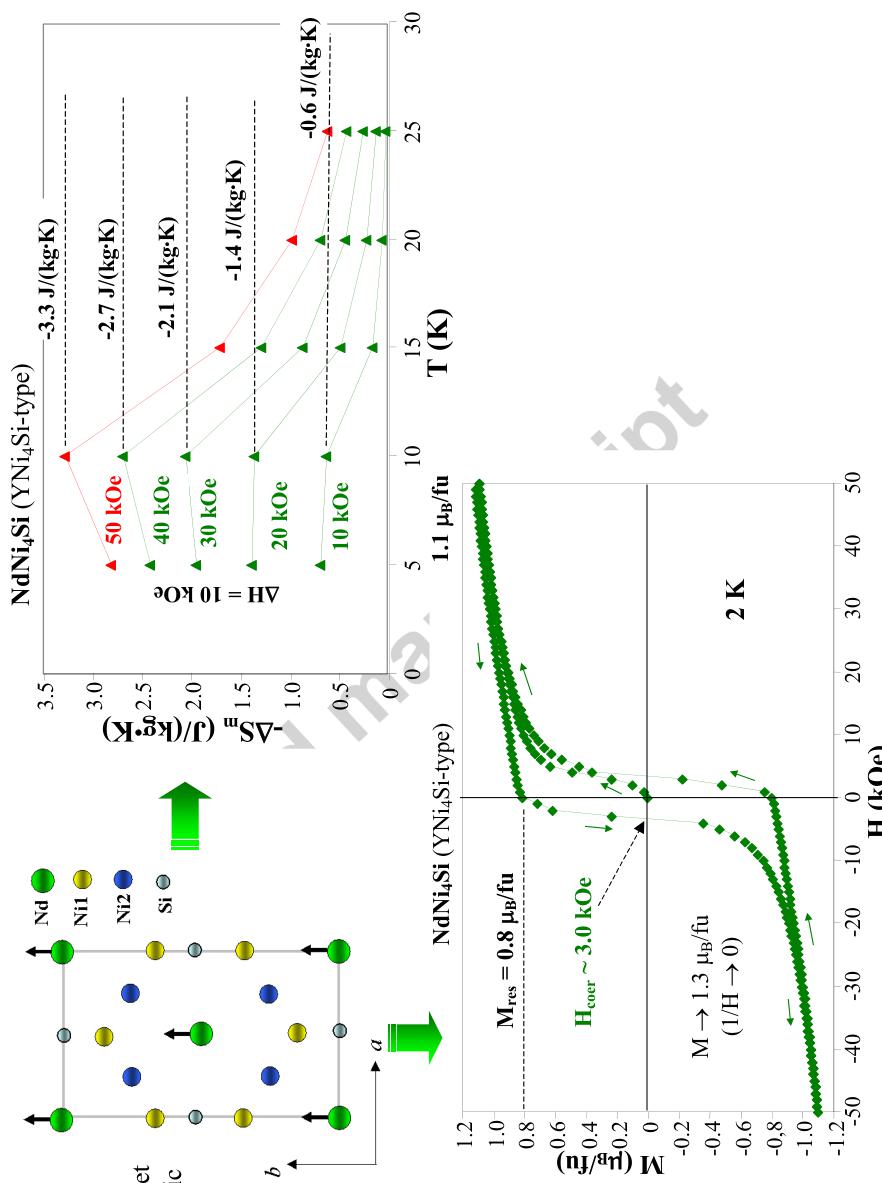
The magnetization vs magnetic field for \( NdNi_{4}Si \) at 2 K is plotted in Fig. 1b. A rapid increase in the magnetization at low fields is typical for a ferromagnet and is attributed to the domain growth. However, a subsequent slow linear increase and non-saturating behavior is indicative of the competing antiferromagnetic interactions and/or strong anisotropy. A strong magnetic anisotropy is likely to be present in the \( NdNi_{4}Si \) structure and does not allow the magnetic moments to be fully oriented in the magnetic field. The saturation magnetic moment reaches the value of 1.1 \( \mu_{B}/Nd \) in 50 kOe, which is significantly smaller than the theoretical saturation moment 3.27 \( \mu_{B} \) of \( Nd^{3+} \) [26]). \( NdNi_{4}Si \) shows the hysteresis at 2 K with residual magnetisation \( M_{res} = 0.8 \mu_{B}/fu \) and coercive field \( H_{coer} = 3.4 kOe \) (Fig. 1b). Existence of significant coercivity in the hysteresis cycle may be an indication of the presence of uniaxial magnetic anisotropy in the \( NdNi_{4}Si \) compound, which is verified as a ferromagnetic ordering along the b axis through the neutron diffraction studies below.
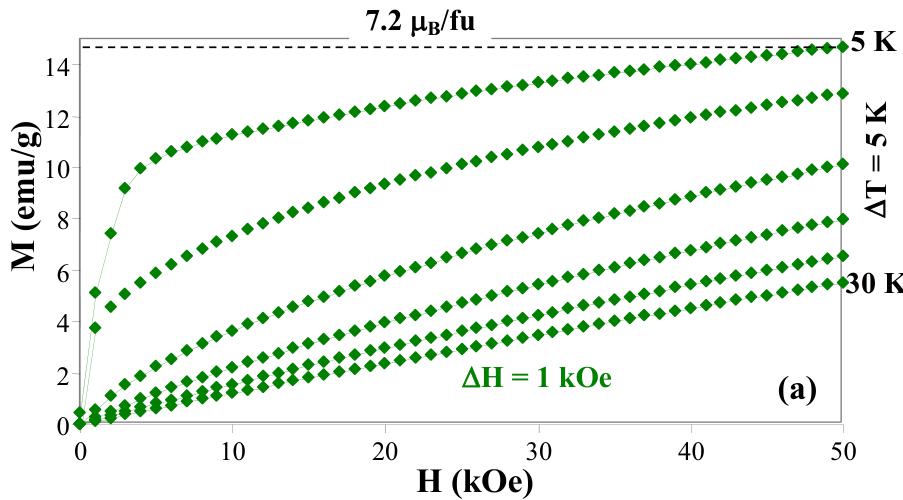
The magnetocaloric effect of \( NdNi_{4}Si \) in terms of the isothermal magnetic entropy change, \( \Delta S_{m} \) , was calculated from the saturation magnetization data (Fig. 2a). A numerical integration is performed
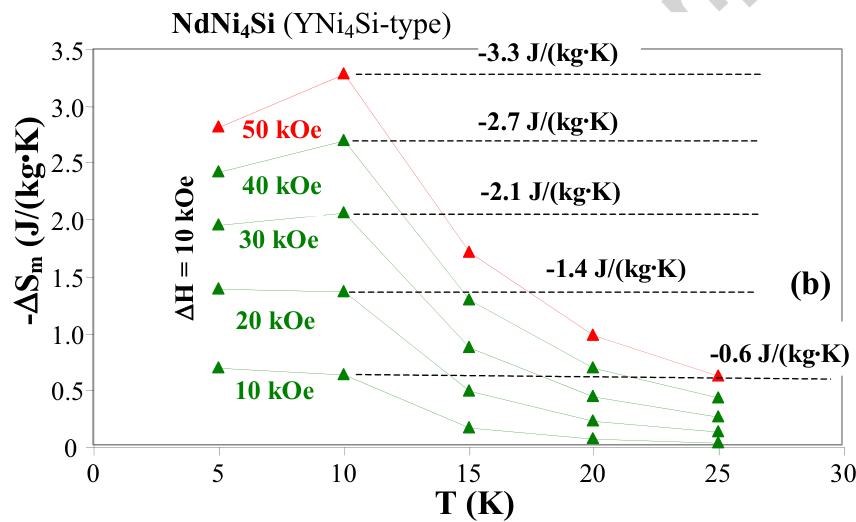
using the following formula \( \Delta S(T)_{mag} = \sum_{i} \frac{M_{i+1} - M_{i}}{T_{i+1} - T_{i}} \Delta H \) , where \( \Delta H \) is a magnetic field step and \( M_{i} \) and \( M_{i+1} \) are the values of magnetization at temperatures \( T_{i} \) and \( T_{i+1} \) , respectively [21]. The magnetic entropy change, \( \Delta S_{m} \) , for \( \Delta H = 0-50 \) kOe is plotted in Fig. 2b. As expected for a second order magnetic transition, \( \Delta S_{m} \) peaks around the Curie temperature and has a maximum value of -3.3 J/kg·K.
4.3. Magnetic structure.
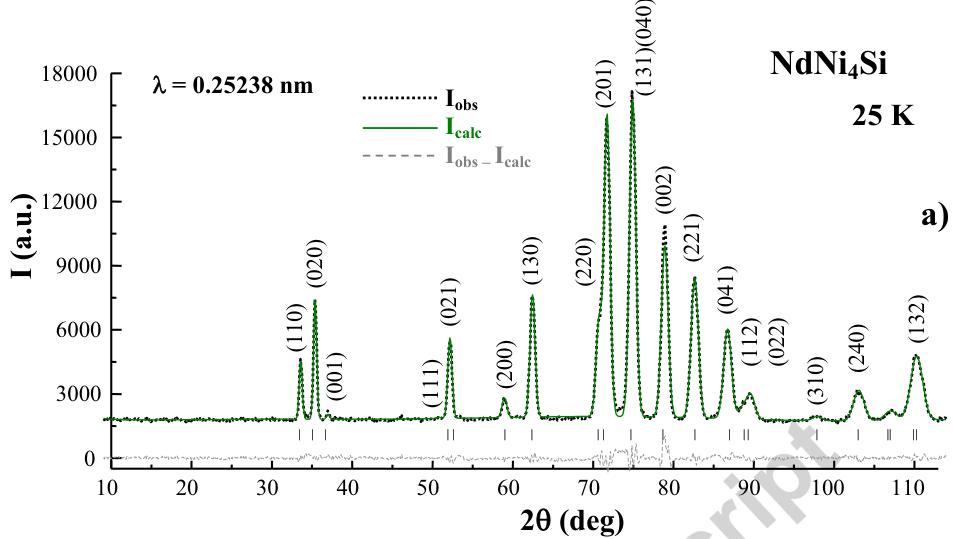
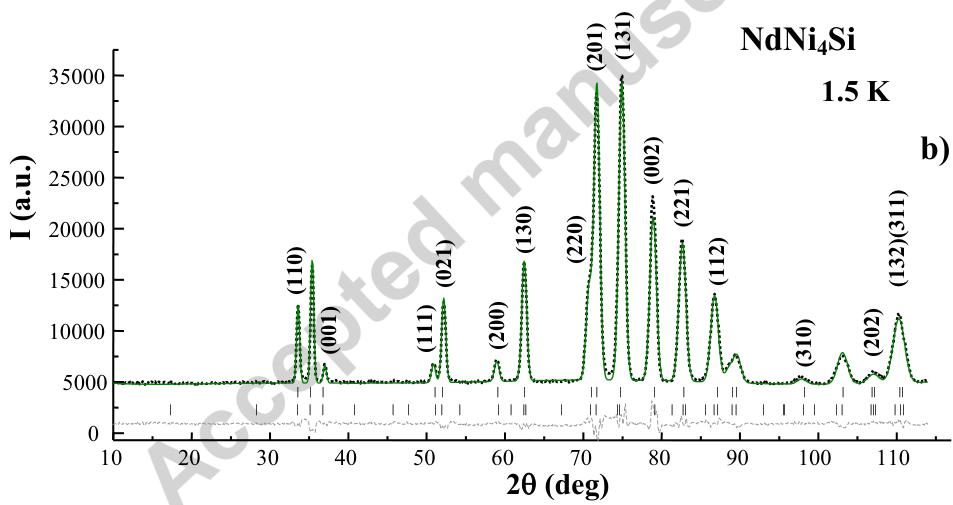
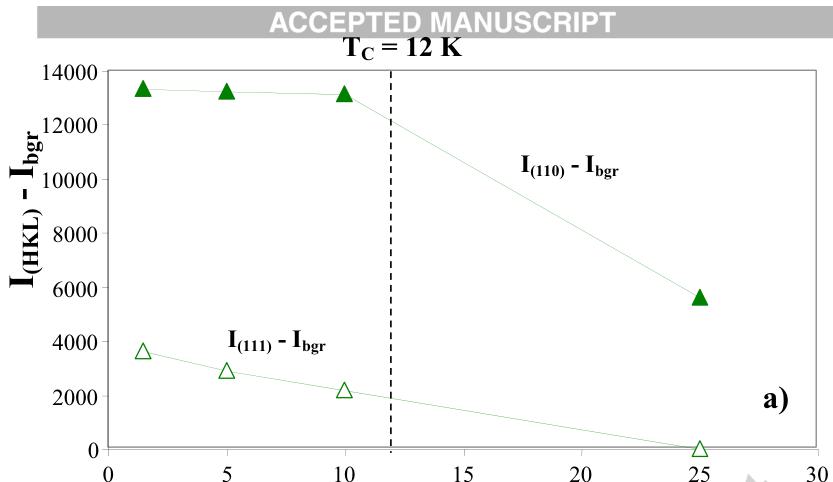
Above 10 K, the neutron diffraction patterns of \( NdNi_{4}Si \) in a zero applied field correspond to the paramagnetic state, and at \( T_{C}^{ND} \sim 10 \) K a set of commensurate magnetic reflections with a \( K_{0} = [0, 0, 0] \) wave vector indicates the magnetic ordering of \( NdNi_{4}Si \) (Fig. 3). The ordering temperature found from the neutron diffraction study is in good agreement with the value deduced from the magnetisation measurements of \( T_{C} \sim 12 \) K (Figs. 1a and 4a).
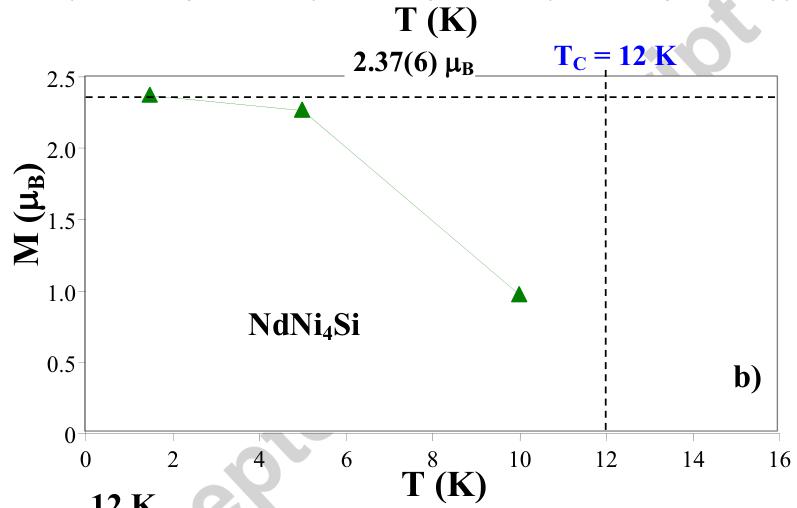
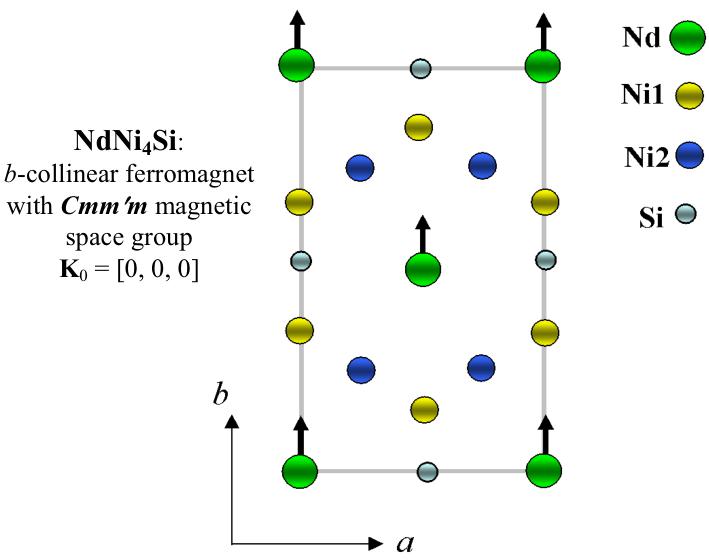
A commensurate b-axis collinear ferromagnetic model of \( NdNi_{4}Si \) fits best with the NDP data (Fig. 5). Within this model, the calculated magnetic moments for the Ni1 and Ni2 sublattices are close to or within the error bar with \( M_{Ni} \sim 0.13(15) \) \( \mu_{B} \) , which means that the significance of such ordered magnetic moment on Ni can not be confirmed. The other tested commensurate variants yielded no magnetic ordering for the Ni sublattices either. The negligible presence of the Ni magnetic moments in this compound results most probably from the Ni-3d band filling via electronic hybridization with the Nd and Ni neighbor states. The b-collinear magnetic ordering of the Nd sublattice corresponds to the Cmm'm magnetic space group as shown in Table 1. The neodymium magnetic moment reaches 2.37(5) \( \mu_{B} \) at 1.5 K, a value less than the theoretical value of 3.27 \( \mu_{B} \) expected for Nd magnetic moment [26] (Fig. 4b and Table 2), which is often observed in some rare-earth-based intermetallic compounds [27, 28].
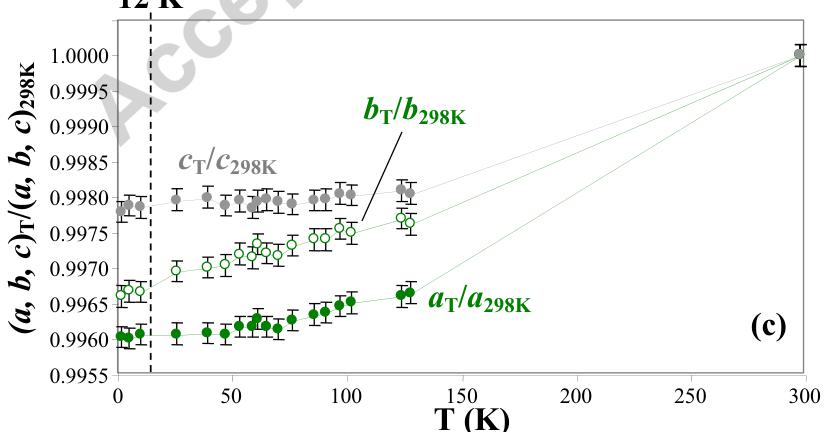
The unit cell of \( NdNi_{4}Si \) undergoes anisotropic distortion down to the ferromagnetic transition temperature: the cell parameters decrease with \( a_{T}/a_{298} < b_{T}/b_{298K} < c_{T}/c_{298K} \) , and below the ferromagnetic ordering the cell parameters remain almost constant (Fig. 4c and Table 2). As the
\( NdNi_{4}Si \) structure is an orthorhombically distorted variant of the hexagonal \( CaCu_{5} \) structure, the \( b/3^{1/2}\cdot a \) ratio can be used to estimate the degree of the distortion and its progression with temperature. The \( b/3^{1/2}\cdot a \) ratio stays almost constant from 298 K to 1.5 K and it is far from the unit value that corresponds to the transformation from the orthorhombic \( YNi_{4}Si \) -type lattice to the hexagonal \( CaCu_{5} \) -type lattice.
5. Discussion
The saturation magnetization at 2 K and in 50 kOe yielded a magnetic moment of \( 1.1 \mu_{B} \) per neodymium atom (Fig. 1b), whereas neutron diffraction studies at 1.5 K and in a zero applied field indicated a complete ferromagnetic ordering of \( NdNi_{4}Si \) with \( 2.37 \mu_{B}/Nd \) (Fig. 4b). It can be understood that a large magnetic anisotropy prevents a parallel alignment of all the Nd moments in the polycrystalline sample with the magnetic field even at 50 kOe.
M. Falkowski et al. [16] reported the magnetic properties of \( CaCu_{5} \) -type \( NdNi_{4}Si \) compound unfortunately without providing crystal data. Based on the aforementioned structural and magnetic data, we propose that transformation from the initial \( CaCu_{5} \) - to the \( YNi_{4}Si \) -type \( NdNi_{4}Si \) unit cell (compression along the b-orthorhombic axis as in \( TbNi_{4}Si \) [12]) leads to the modification in the Nd environment and thus the changes in their magnetic properties, such as, increasing of temperature of magnetic ordering from 9.2 K up to 12 K, reorientation the neodymium moments in the ab-plane normal to the compression of unit cell, decreasing of magnetocaloric effect from -7.3 J/kg·K of \( CaCu_{5} \) -type \( NdNi_{4}Si_{2} \) down to -3.3 J/kg·K of \( YNi_{4}Si \) -type \( NdNi_{4}Si_{2} \) in field of 0-50 kOe as in \( TbNi_{4}Si \) [12]. Such a transformation leads to the appearance of distinct hysteresis loop at 2 K of the \( YNi_{4}Si \) -type \( NdNi_{4}Se_{2} \) in contrast with the \( CaCu_{5} \) -type \( NdNi_{4}Se_{2} \) (Table 3).
6. Conclusions
The new \( YNi_{4}Si \) -type \( NdNi_{4}Si \( supplements the series of \) YNi_{4}Si \( -type \) RNi_{4}Si \( compounds with \) R = Y, La, Ce, Sm, Gd - Ho. Compared to the ) CaCu_{5} \( -type \) NdNi_{4}Si \( compound, the \) YNi_{4}Si \( -type counterpart has the relatively high ferromagnetic ordering temperature (9.2 K vs. 12 K), the small magnetocaloric --- effect (-7.3 J/kg·K vs. -3.3 J/kg·K for \( \Delta H=50 \) kOe), and the large magnetic anisotropy at low temperatures. This work suggests that such an orthorhombic distortion from the initial \( CaCu_{5} \) -type unit cell can take place in the other \( YNi_{4}Si \) -type solid solutions, e.g., \( PrNi_{4}Si \) . The orthorhombic distortion may be used as a prospective route for optimisation of permanent magnetic properties in the family of \( CaCu_{5} \) -type rare earth materials.
Acknowledgements
This work was supported by the Russian Fund for Basic Research (Grant Nos. 12-03-00428-a and 13-02-00916), the National Natural Science Foundation of China (Grant No. 51301116), and the Natural Science Foundation of Jiangsu Province (Grant No. BK20130261). The Institute Laue Langevin (Grenoble, France) is warmly acknowledged for the use of the neutron diffraction beam. Y.S.K. thank "Regional Materials Science and Technology Centre - Feasibility Program" of Czech Republic under Grant Nos. CZ.1.07/2.3.00/30.0016 and LO1203 for financial support.
References
[1] A.V. Morozkin, A.V. Knotko, V.O. Yapaskurt, Fang Yuan, Y. Mozharivskyj, R. Nirmala, J. Solid State Chem. 208 (2013) 9-13.
[2] P. Villars, L.D. Calvert, Pearson’s Handbook of Crystallographic Data for Intermetallic Phases, ASM International, Materials Park, Ohio, 1985.
[3] SpringerMaterials The Landolt-Börnstein Database - Materials Science Data for 250000 Substances. http://www.springermaterials.com.
[4] K.J. Strnat, Ferromagnetic Materials, in: 131th ed., in: E.P. Wohlfarth, K.H.J. Buschow (Eds.), Elsevier Science, North-Holland, Amsterdam, 1988.
[5] E. Burzo, A. Chelkowski, H.R. Kirchmayr, Magnetic Properties of Metals, 248th ed., Springer-Verlag, Landolt-Börnstein, 1990.
[6] S.N. Klyamkin, V.N. Verbetsky, A.A. Karih, J. Alloys Compd. 231 (1995) 479-482.
[7] T. Tolinski, M. Falkowski, K. Synoradzki, A. Hoser, N. Stuber, J. Alloys Compd. 523 (2012) 43-48.
[8] N. Bucur, E. Burzo, R. Tetean, J. Optoelectron. Adv. Mater. 10 (2008) 801.
[9] M. Falkowski, B. Andrzejewski, A. Kowalczyk, J. Alloys Compd. 442 (2007) 155-157.
[10] L. Morellon, P.A. Algarabel, M.R. Ibarra, A.D. Moral, D. Gignoux, D. Schmitt, J. Magn. Magn. Mater. 153 (1996) 17.
[11] G. Aubert, D. Gignoux, B. Hennion, B. Michelutti, A.N. Saada, Solid State Commun. 37 (1981) 741-743.
[12] A.V. Morozkin, F. Yuan, Y. Mozharivskyj, O. Isnard, J. Magn. Magn. Mater. 368 (2014) 121-125.
[13] A.V. Morozkin, R. Nirmala, S.K. Malik, Magnetism and magnetocaloric effect in \( YNi_{4}Si \) -type \( RNi_{4}Si \) (R = Ce, Gd, Tb and Dy) compounds (submitted to J. Magn. Magn. Mater.)
[14] R.J. Radwanski, N.H.K. Ngan, J. Alloys Compd. 219 (1995) 260-263.
[15] P.J. von Ranke, M.A. Mota, D.F. Grangeia, A.M.G. Carvalho, F.C.G. Gandra, A.A. Coelho, A. Caldas, N.A. de Oliveira, S. Gama, Phys. Rev. B 70 (2004) 134428.
[16] M. Falkowski, T. Tolinski, A. Kowalczyk, Acta Phys. Pol. A 121 (2012) 1290-1292.
[17] www.ill.eu, Yellow Book.
[18] F. Izumi, in: R.A. Young (Ed.), The Rietveld Method, Oxford University Press, Oxford, 1993, p. 13.
[19] F. Izumi, Rigaku J. 6 (1989) 10.
[20] R.A. Levy, Principles of Solid State Physics, Academic Press, New York, 1968.
[21] A.M. Tishin, Y.L. Spichkin, The Magnetocaloric Effect and Its Applications, Institute of Physics Publishing, Bristol, Philadelphia, 2003, p. 480.
[22] J. Rodriguez-Carvajal, Physica B 192 (1993) 55-69.
[23] C.J. Bradley, A.P. Cracknell, The Mathematical Theory of Symmetry in Solids, Clarendon, Oxford 1972.
[24] D.B. Litvin, Magnetic Group Tables, 1-, 2- and 3-Dimensional Magnetic Subperiodic Groups and Magnetic Space Groups, International Union of Crystallography, 2013.
[25] M. Falkowski, M. Pugaczowa-Michalska, A. Kowalczyk, J. Alloys Compd. 577 (2013) 19-24.
[26] S. Legvold, Rare Earth Metals and Alloys, in: E.P. Wohlfarth (Ed.), Ferromagnetic Materials (North-Holland Publishing Company, Amsterdam, 1980, pp. 183-295.
[27] C. Chacon, O. Isnard, S. Miraglia, J. Alloys Compd. 283 (1999) 320-326.
[28] C. Zlotea, C. Chacon, O. Isnard, J. Appl. Phys. 92 (2002) 7382.
Figure Captions
Fig. 1. (a) Magnetization and inverse magnetic susceptibility of \( NdNi_{4}Si \) as a function of temperature in 5 kOe and (b) magnetization vs. magnetic field of \( NdNi_{4}Si \) at 2 K.
Fig. 2. (a) Magnetization vs. magnetic field and (b) the isothermal entropy change, \( -\Delta S_{m} \) , of \( NdNi_{4}Si \) around the magnetic transition.
Fig. 3. Neutron diffraction patterns of \( NdNi_{4}Si \) (a) at 25 K (paramagnetic state) and (b) at 1.5 K (b-axis ferromagnet with \( K_{0} = [0, 0, 0] \) wave vector. The first row of ticks refers to the nuclear Bragg peaks whereas the second row of lines refers to the magnetic reflections. The (hkl) of strongest magnetic reflections are indicated in Figure 3b.
Fig. 4. Thermal evolution of (a) strongest magnetic reflections \( I_{(HKL)} \) in the neutron diffraction patterns of \( NdNi_{4}Si \) , (b) the magnetic moments of Nd atom (along b axis) and (c) of relative cell parameters
\( a_{T}/a_{298K} \) , \( b_{T}/b_{298K} \) and \( c_{T}/c_{298K} \) . Here \( a_{T} \) , \( b_{T} \) , \( c_{T} \) , \( a_{298K} \) , \( b_{298K} \) and \( c_{298K} \) are cell parameters of \( NdNi_{4}Si \) at a given temperature T and 298 K, respectively.
Fig. 5. The magnetic structure of \( YNi_{4}Si \) -type \( NdNi_{4}Si \) with b-axis collinear ferromagnetic ordering of Nd sublattice below \( \sim12 \) K of Cmm'm magnetic space group ( \( K_{0}=[0,0,0] \) wave vector).
Table 1.
Atomic positions for the 2a, 4i and 4f sites of the \( Cmmm^{\alpha} \) space group (retained by \( NdNi_{4}Si \) ) with the corresponding symmetry operators and magnetic space group \( Cmm'm^{\beta} \) (retained by b-axis collinear ferromagnetic ordering of \( NdNi_{4}Si \) ) with corresponding magnetic symmetry operators.
| Site | Atom | x/a | y/b | z/c | Symmetry operator | Magnetic symmetry operator |
| 2a | Tb¹ | 0 | 0 | 0 | Pmmm⁰ | Pmm⁰m⁰ |
| Tb² | 1/2 | 1/2 | 1/2 | Pmmm/[1/2 0 1/2] | Pmm⁰m×1/[1/2 0 1/2] | |
| 4i | Ni1¹ | 0 | y | 0 | Pm2m⁰ | Pm2m⁰ |
| Ni1² | 0 | -y | 0 | {2x, mz, 2z, 1} | 1′×{2x, mz, 2z, 1} | |
| Ni1³ | 1/2 | 1/2+y | 0 | Pm2m/[1/2 1/2 0] | Pm2m×1/[1/2 1/2 0] | |
| Ni1⁴ | 1/2 | 1/2-y | 0 | {2x, mz, 2z, 1}/[1/2 1/2 0] | 1′×{2x, mz, 2z, 1}/[1/2 0 1] | |
| 4f | Ni2¹ | 1/4 | 1/4 | 1/2 | P2₁/n⁰ | P2₁/n⁰ |
| Ni2² | -1/4 | 1/4 | 1/2 | {mx, 2x/[1/2 1/2 0], 2y, mz/[1/2 1/2 0]} | {mx, 1′×2x/[1/2 1/2 0], 2y, 1′×mz/[1/2 1/2 0]} | |
| Ni2³ | 1/4 | -1/4 | 1/2 | {mx/[1/2 1/2 0], 2x, 2y/[1/2 1/2 0], mz} | {mx/[1/2 1/2 0], 1′×2x, 2y/[1/2 1/2 0], 1′×mz} | |
| Ni2⁴ | -1/4 | -1/4 | 1/2 | P2₁/n/[1/2 1/2 0] | P2₁/n/[1/2 1/2 0] |
\( ^{a} \) Cmmm = \( \{1, m_{x}, m_{y}, m_{z}, \overline{1}, 2_{x}, 2_{y}, 2_{z}\} \times \{1, 1/[1/2, 1/2, 0]\} = Pmmm \times \{1, 1/[1/2, 1/2, 0\} \) ;
\( ^{b} \) Cmm'm = \( \{1, m_{x}, 1'\times m_{y}, m_{z}, 1'\times \overline{1}, 1', 1'\times 2_{x}, 2_{y}, 1'\times 2_{z}\}\times\{1, 1/[1/2, 1/2, 0]\} = \{1, m_{x}, 2_{y}, m_{z}\}\times\{1, 1'\times \overline{1}\}\times\{1, 1/[1/2, 1/2, 1/2, 0]\} = Pmm'm\times\{1, 1/[1/2, 1/2, 0]\} \)
\( ^{c} \) Pmmm = \( \{1, m_{x}, m_{y}, m_{z}, 1, 2_{x}, 2_{y}, 2_{z}\} \) ;
\( ^{d} \) Pm2m = \( \{1, m_{x}, 2_{y}, m_{z}\} \) ;
\( ^{e} \) P2 \( _{1} \) /n = \( \{1, m_{z}, 2_{z}/[1/2 1/2 0], 1/[1/2 1/2 0]\} \) ;
\( ^{f} \) Pmm'm = \( \{1, m_{x}, 1'\times m_{y, m_{z}, 1'\times 1, 1'\times 2, 2, 1'\times 2\}} = Pmm2m \times \{1, 1'\times m_{y}\} \) ;
\( ^{g} \) Pm2m = Pm2m = \( \{1, m_{x}, 2_{y}, mz\} \) ;
\( ^{h} \) P2 \( _{1} \) /n = \( \{1, mz, 1'\times 2_{z}/[1/2 1/2 0], 1'\times \overline{1}/[1/2 1/2 0]\} = \{1, m_{z}\} \times \{1, 1'\times 2_{z}/[1/2 1/2 1]\} \) ;
Table 2. Crystallographic and magnetic parameters of \( YNi_{4}Si \) -type \( NdNi_{4}Si \) at different temperatures: cell parameters a, b and c, unit cell volume \( V, b/(3^{1/2}\cdot a) \) ratio, the atomic position of Ni1 atom \( y_{Ni1}^{a} \) , \( M_{b}^{K0} \) the magnetic moments of Nd along the b-axis with \( K_{0}=[0,0,0] \) wave vector. Reliability factors are: \( R_{F} \) for the crystal structure and \( R_{F}^{m} \) for the magnetic structure.
| T (K) | Cell parameters | V (nm3) | b/(31/2·a) | yNi1 | RF (%) | Atom | MBK0(μB) | RFm(%) | |
| 298b | a=0.51354(2) nm | 0.16926(4) | 0.93320(5) | 0.3424(5) | 4.5 | ||||
| b=0.83006(3) nm | |||||||||
| c=0.39707(1) nm | |||||||||
| 128 | a=0.51259(5) nm | 0.16872(9) | 0.93411(9) | 0.3411(3) | 3.6 | ||||
| b=0.82933(9) nm | |||||||||
| c=0.39689(4) nm | |||||||||
| 25 | a=0.51224(5) nm | 0.16842(9) | 0.93398(9) | 0.3412(3) | 3.4 | ||||
| b=0.82865(9) nm | |||||||||
| c=0.39678(3) nm | |||||||||
| 10 | a=0.51229(4) nm | 0.16843(9) | 0.93376(8) | 0.3413(3) | 3.6 | Nd1, Nd2 | 0.97(12) | 9.1 | |
| b=0.82854(7) nm | |||||||||
| c=0.39682(3) nm | |||||||||
| 5 | a=0.51226(4) nm | 0.16843(8) | 0.93383(8) | 0.3410(2) | 3.1 | Nd1, Nd2 | 2.26(6) | 5.4 | |
| b=0.82855(7) nm | |||||||||
| c=0.39683(3) nm | |||||||||
| 1.5 | a=0.51228(4) nm | 0.16841(7) | 0.93373(7) | 0.3412(2) | 3.0 | Nd1, Nd2 | 2.37(5) | 5.4 | |
| b=0.82849(6) nm | |||||||||
| c= 0.39679(2) nm |
\( ^{a} \) Atomic sites of \( YNi_{4}Si \) -type \( NdNi_{4} Si \) (space group Cmmm): Nd (2a) [0, 0, 0], Ni1 (4i) [0, 0.3424(5), 0], Ni2 (4f) [1/4, 1/4, 1/2] and Si (2c) [0, 1/2, 1/2].
\( ^{b} \) -X-ray data.
Table 3. Magnetic properties of CaCu_{5}-type NdNi_{5}, NdNi_{4}Si and YNi_{4}Si-type NdNi_{4}Si compounds.
| Compound | Type structure | \( \Theta_{\mathrm{P}} \) (K) | \( M_{\mathrm{eff}} \) ( \( \mu_{\mathrm{B}}/\mathrm{fu} \) ) | \( T_{\mathrm{C}} \) (K) | \( M_{\mathrm{sat}} \) ( \( \mu_{\mathrm{B}}/\mathrm{fu} \) ) | \( M_{\mathrm{res}} \) ( \( \mu_{\mathrm{B}}/\mathrm{fu} \) ) (2 K) | \( H_{\mathrm{coer}} \) (kOe) (2 K) | \( \Delta S_{\mathrm{m}} \) (J/kg·K) (0-50 kOe) | Ref. |
| NdNi \( _{5} \) | CaCu \( _{5} \) | 7.2 | 2.1 | -8.45 | |||||
| NdNi \( _{4} \) Si | CaCu \( _{5} \) | 9.2 | 1.5 (4.2 K, 90 kOe) | - | - | -7.3 | [16] | ||
| NdNi \( _{4} \) Si | YNi \( _{4} \) Si | -21 | 3.8 | 12 | 1.1 (2 K, 50 kOe) | 0.8 | -3.0 | -3.3 | a- |
\( ^{a} \) This work.
Magnetic order and crystal structure study of YNi_{4}Si-type NdNi_{4}Si
Jinlei Yao, O. Isnard, A. V. Morozkin \( ^{*} \) , T.I. Ivanova, Yu. S. Koshkid'ko, A. E. Bogdanov, S. A. Nikitin, W. Suski
Below ~12 K the YNi_{4}Si-type NdNi_{4}Si shows a ferromagnetic ordering.
MCE of NdNi_{4}Si reaches value of -3.3 J/kg·K in 0-50 kOe near Curie point.
NdNi_{4}Si exhibits b-axis ferromagnetic order with the Cmm m magnetic space group.
Contrary to CaCu_{5}-type, YNi_{4}Si-type NdNi_{4}Si shows hysteresis loop at 2 K.


Fig. 1. (a) Magnetization and inverse magnetic susceptibility of \( NdNi_{4}Si \) as a function of temperature in 5 kOe and (b) magnetisation vs. magnetic field of \( NdNi_{4}Si \) at 2 K.


Fig. 2. (a) Magnetization vs. magnetic field and (b) the isothermal entropy change, \( -\Delta S_{m} \) , of \( NdNi_{4}Si \) around the magnetic transition.


Fig. 3. Neutron diffraction patterns of \( NdNi_{4}Si \) (a) at 25 K (paramagnetic state) and (b) at 1.5 K (b-axis ferromagnet with \( K_{0} = [0, 0, 0] \) wave vector. The first row of ticks refers to the nuclear Bragg peaks whereas the second row of lines refers to the magnetic reflections. The (hkl) of strongest magnetic reflections are indicated in Figure 3b.


Fig. 4. Thermal evolution of (a) strongest magnetic reflections \( I_{(HKL)} \) in the neutron diffraction patterns of \( NdNi_{4}Si \) , (b) the magnetic moments of Nd atom (along b axis) and (c) of relative cell parameters \( a_{T}/a_{298K} \) , \( b_{T}/b_{298K} \) and \( c_{T}/c_{298K} \) . Here \( a_{T} \) , \( b_{T} \) , \( c_{T} \) , \( a_{298K} \) , \( b_{298K} \) and \( c_{298K} \) are cell parameters of \( NdNi_{4}Si \) at a given temperature T and 298 K, respectively.

Fig. 5. The magnetic structure of \( YNi_{4}Si \) -type \( NdNi_{4}Si \) with b-axis collinear ferromagnetic ordering of Nd sublattice below \( \sim12 \) K of \( Cmm'm \) magnetic space group ( \( K_{0}=[0,0,0] \) wave vector).

Magnetite order and crystal structure study of YNiSi-type NdNiAlSi
\( ^{*} \) Graphical Abstract (TOC Figure)
Jinlei Yao, Q. Isnard, A. V. Morozkin \( ^{*} \) T1, Ivannova, Yu. S. Koshkild'ko, A. E. Bogdanov, S. A. Nikitin, W. Suski
Magnetic order and crystal structure study of YNi_{4}Si-type NdNi_{4}Si
Jinlei Yao, O. Isnard, A. V. Morozkin \( ^{*} \) , T.I. Ivanova, Yu. S. Koshkid'ko, A. E. Bogdanov, S. A. Nikitin, W. Suski
The \( NdNi_{4}Si \) supplement the series of the orthorhombic derivative of the \( CaCu_{5} \) -type, namely the \( YNi_{4}Si \) -type, \( RNi_{4}Si \) compounds (R = Y, La, Ce, Sm, Gd - Ho). Below ~12 K in a zero applied magnetic field, \( NdNi_{4}Si \) exhibits a commensurate b-axis collinear ferromagnetic ordering with the Cmm'm magnetic space group. Compared to the \( CaCu_{5} \) -type \( NdNi_{4}Si \) compound, the \( YNi_{4}Si \) -type counterpart has the relatively high ferromagnetic ordering temperature (9.2 K vs. 12 K), the small magnetocaloric effect (-7.3 J/kg·K vs. -3.3 J/kg·K for \( \Delta H=50 \) kOe), and the large magnetic anisotropy at low temperatures. In contrast with \( CaCu_{5} \) -type \( NdNi_{4}Si \) , \( YNi_{4}Si \) -type \( NdNi_{4}Si \) shows distinct hysteresis loop at 2 K.
We suggest that orthorhombic distortion may be used as a prospective route for optimisation of permanent magnetic properties in the family of \( CaCu_{5} \) -type rare earth materials.
 p17_0.jpg
 p17_1.jpg
 p18_0.jpg
 p18_1.jpg
 p19_0.jpg
 p19_1.jpg
 p1_0.jpg
 p20_0.jpg
 p20_1.jpg
 p20_2.jpg
 p21_0.jpg
 p22_0.jpg