| Transition Temperature | 137 K |
|---|---|
| Experiment Temperature | 53 K |
| Propagation Vector | k1 (0, 0, 0) |
| Parent Space Group | Cmcm (#63) |
| Magnetic Space Group | Cm'cm' (#63.464) |
| Magnetic Point Group | m'm'm (8.4.27) |
| Lattice Parameters | 4.0751 10.0979 12.29425 90.00 90.00 90.00 |
|---|---|
| DOI | 10.1016/j.jssc.2017.04.009 |
| Reference | A. Morozkin, A. Garshev, A. Knotko, V. Yapaskurt, O. Isnard, J. Yao, R. Nirmala, S. Quezado and S. Malik, Journal of Solid State Chemistry (2017) 251 33-42. |
| Label | Element | Mx | My | Mz | |M| |
|---|---|---|---|---|---|
| Tb1 | Tb | 0.0 | 7.8 | -4.02 | 8.77 |
| Tb2 | Tb | 0.0 | 5.5 | 0.0 | 5.50 |
| Co1 | Co | 0.0 | -0.35 | -0.18 | 0.39 |
| Co2 | Co | 0.0 | -0.18 | 0.0 | 0.18 |
Author’s Accepted Manuscript
W_{3}CoB_{3}-type {Y, Gd - Ho}{3}Co{4-x}Al_{x} (x = 0.5 - 1) rare earth compounds: specific features of crystal structure and magnetic ordering
A.V. Morozkin, A.V. Garshev, A.V. Knotko, V.O. Yapaskurt, O. Isnard, Jinlei Yao, R. Nirmala, S. Quezado, S.K. Malik

www.elsevier.com/locate/yjssc
PII: S0022-4596(17)30120-2 DOI: http://dx.doi.org/10.1016/j.jssc.2017.04.009 Reference: YJSSC19742
To appear in: Journal of Solid State Chemistry
Received date: 13 February 2017 Revised date: 13 March 2017 Accepted date: 8 April 2017
Cite this article as: A.V. Morozkin, A.V. Garshev, A.V. Knotko, W.O. Yapaskurt, O. Isnard, Jinlei Yao, R. Nirma, S. Quezado and S.K. Malik W \( _{3} \) CoB \( _{3} \) -type {Y, Gd - Ho} \( _{3} \) Co \( _{4-x} \) Al \( _{x} \) (x = 0.5 - 1) rare earth compounds specific features of crystal structure and magnetic ordering, Journal of Soli State Chemistry, http://dx.doi.org/10.1016/j.jssc.2017.04.
This is a PDF file of an unedited manuscript that has been accepted for publication. As a service to our customers we are providing this early version of the manuscript. The manuscript will undergo copyediting, typesetting, an review of the resulting galley proof before it is published in its final citable form. Please note that during the production process errors may be discovered which could affect the content, and all legal disclaimers that apply to the journal pertain
W_{3}CoB_{3}-type {Y, Gd - Ho}{3}Co{4-x}Al_{x} (x = 0.5 - 1) rare earth compounds: specific features of crystal structure and magnetic ordering
A. V. Morozkin \( ^{a*} \) , A.V. Garshev \( ^{a,b} \) , A.V. Knotko \( ^{a,b} \) , V.O. Yapaskurt \( ^{c} \) , O. Isnard \( ^{d,e} \) , Jinlei Yao \( ^{f} \) , R. Nirmala \( ^{g} \) , S. Quezado \( ^{h} \) , S.K. Malik \( ^{h} \)
\( ^{a} \) Department of Chemistry, Moscow State University, Leninskie Gory, House 1, Building 3, Moscow, GSP-2, 119992, Russia
\( ^{b} \) Faculty of Materials Science, Moscow State University, Leninskie Gory, House 1, Building 73, Moscow, GSP-1, 119991, Russia
\( ^{c} \) Department of Petrology, Geological Faculty Moscow State University, Leninskie Gory, Moscow, 119992, Russia
\( ^{d} \) CNRS, Insitut. Néel, 25 rue des Martyrs BP166 x F-38042 Grenoble, France
\( ^{e} \) Université Grenoble Alpes, Inst. Néel, F-38042 Grenoble, France
\( ^{f} \) Jiangsu Key Laboratory of Micro and Nano Heat Fluid Flow Technology and Energy Application, School of Mathematics and Physics, Suzhou University of Science and Technology, Suzhou 215009, China
\( ^{g} \) Indian Institute of Technology Madras, Chennai 600 036, India
\( ^{h} \) Departamento de Física Teórica e Experimental, Universidade Federal do Rio Grande do Norte, Natal, 59082-970, Brazil
\( ^{*} \) Corresponding author: morozkin@tech.chem.msu.ru
Abstract
The crystal structure of new \( W_{3}CoB_{3} \) -type \( \{Y, Gd - Ho\}_{3}Co_{3.25}Al_{0.75} \) , \( Gd_{3}Co_{3.5}Al_{0.5} \) and \( Tb_{3}Co_{3}Al \) compounds (Cmcm. N 63, oC28) has been established using powder X-ray diffraction studies. The magnetic properties of \( Gd_{3}Co_{3.5}Al_{0.5} \) , \( Gd_{3}Co_{3.25}Al_{0.75} \) and \( Tb_{3}Co_{3.25}Al_{0.75} \) were determined by bulk magnetization measurements and neutron diffraction studies. \( Gd_{3}Co_{0.5}Al_{0.5} \) , \( Gd_{3}Co_{0.25}Al_{0.75} \) and \( Tb_{3}Cu_{0.25}Al_{0.75} \) exhibit ferrimagnetic ordering below 196 K, 161 K and 151 K, respectively.
\( Tb_{3}Co_{3.25}Al_{0.75} \) shows a spin-reorientation transition at \( \sim \) 42 K. Below the ferrimagnetic ordering temperature \( Gd_{3}Co_{3.25}Al_{0.75} \) and \( Tb_{3}Co_{3.25}Al_{0.75} \) , are soft ferrimagnets, meanwhile \( Tb_{3}Co_{3.25}Al_{0.75} \( shows magnetic hardness below the spin-reorientation transition with remanent magnetization per formula unit of \) 9.7 \mu_{B} \( and coercive field of 15 kOe at 2 K. The magnetocaloric effects of \( Gd_{3}Co_{3.25}Al_{0.75} \) , and \( Tb_{3}Co_{3.25}Al_{0.75}\) were calculated in terms of isothermal magnetic entropy change and they reach maximum values of -4.9 J/kg·K at 135-145 K and -3.7 J/kg·K at 115-135 K, respectively, for a field change of 0-50 kOe. Low temperature magnetic ordering in \( Tb_{3}Co_{3.25}Al_{0.75} is accompanied by a positive magnetocaloric effect with isothermal magnetic entropy changes of +13.6 J/kg·K at 10 K for a field change of 0-50 kOe and +0.9 J/kg·K at 45 K for a field change of 0-10 kOe. Neutron diffraction study in zero applied field shows mixed ferro-antiferromagnetic ordering of \( Tb_{3}Co_{3.25}Al_{0.75} with a wave vector K_{0} = [0, 0, 0] \). Below ~ 137 K \( Tb_{3}Co_{3.25}Al_{0.75} exhibits non-collinear ferrimagnetic ordering of terbium and cobalt sublattices with resulting of b-axis ferromagnetic and c-axis antiferromagnetic components of Cm' m = {1, m_{x}} × {1, m_{z}/[0, 0, 1/2]} × {1, i'} × {1, 1/[1/2, 1/2, 0]} magnetic space group. The spin-reorientation transition in \( Tb_{3}Co_{3.25}Al_{0.75}\) below ~38 K corresponds to appearance of additional a-axis ferromagnetic component and decreasing of symmetry of magnetic ordering down to C2'/c = {1, m_{z}/[0, 0, 1/2]} ×{1, i'} × {1, 1/[1/2, 1/2 , 0]} magnetic space group.
Key words: Rare earth compounds; Magnetic properties; Magnetocaloric effect; Neutron diffraction; Magnetic structure
1. Introduction
Intermetallic compounds composed of rare earth, transition metal and p-elements are being actively studied for the occurrence of large magnetocaloric effect over suitable temperature ranges for
applications in magnetic refrigeration/heating technologies and for the occurrence of giant coercive force as potential basis for permanent magnets.
The \( R_{3}Ge_{4} \) (R = Rare earth) compounds displayed an intricate canted antiferromagnetic structure with two inequivalent sites for rare earth [1-2]. In particular, the \( Er_{3}Ge_{4} \) compound undergoes an antiferromagnetic transition and a spin-reorientation transition and the entropy involved in spin-reorientation transition has been found to be larger in the earlier calorimetric studies [2]. Transition metal (Co, Fe, etc) substitution at the p-element site yielded interesting structural and magnetic properties [3-6]. Novel rare earth intermetallic compounds \( \{Y, Gd - Ho\}_{3}Co_{4-x}Al_{x} \) (x = 0.5-1) crystallize in the \( W_{3}CoB_{3} \) -type structure (the ordered variant of \( Er_{3}Ge_{4} \) -type structure), such as \( Er_{3}FeGe_{3} \) [3], \( Gd_{3}Co_{2.48}Si_{1.52} \) [4], \( \{Y, Gd, Dy - Tm\}_{3}Co_{2.2}Si_{1.8} \) [5] and \( \{Y, Pr, Nd, Sm, Gd, Tb\}_{3}Co_{3}Ga \) [6]. These compounds belong to a large family of the two-layer orthorhombic structures with the Cmcm space group symmetry [5]. The structure is derived from the Mg-type rare earths via orthorhombic distortion of the initial hexagonal rare-earth lattice with the insertion of transition metals and p elements.
Till now the magnetic properties of \( Er_{3}FeGe_{3} \) [3] and \( \{Y, Pr, Nd, Sm, Gd, Tb\}_{2}Co_{3}Ga \) [6] were not investigated, whereas \( Gd_{3}Co_{2.48}Si_{1.52} \) \( [4] \) and \( \{Y, Gd, Dy - Tm\}_{3}Co_{2.2}S_{1.8} \) [5] exhibit complex ferro-antiferromagnetic ordering: \( Gd_{3}Co_{2.2}Si_{1.8} \) behaves as soft ferrimagnetic below Curie point [7], whereas \( \{Tb, Dy\}_{3}Co_{2.2}Si_{1.8} \) are soft ferrimagnets below Curie points and they exhibit hard magnetic properties below the spin-reorientation temperature [8]. Neutron diffraction study in zero applied field indicates mixed ferro-antiferromagnetic of \( Tb_{3}Co_{2.2}Si_{1.8} \) with wave vectors \( K_{0} = [0, 0, 0] \) and \( K_{1} = [\pm K_{x}, 0, 0] \) ( \( K_{x} \approx 3/10 \) ): below \( T_{C} = 125 \) K the magnetic structure of \( Tb_{3}Co_{2.2}Si_{1.8}} \) is a set of canted ferromagnetic cones with a resulting b-axis ferromagnetic component and below \( T_{SR} = 42 \) K its magnetic structure is a set of canted ferromagnetic cones with a resulting c-axis ferromagnetic component (between 53 K and 42 K the high-temperature magnetic order of \( Tb_{3}Co_{2.2}Si_{1.8}) \) transforms to the low-temperature order via an intermediate state) [8].
This work reports the crystal structure of \( \{Y, Gd - Ho\}_{3}Co_{4-x}Al_{x} \) (x = 0.5-1) compounds, magnetic properties of \( Gd_{3}Co_{3.5}Al_{0.5} \) , \( Gd_{3}Co_{3.25}Al_{0.75} \) and \( Tb_{3}Co_{3.25}Al_{0.75} \) compounds and magnetic structure of \( Tb_{3}Co_{3.25}Al_{0.75} from neutron diffraction study in zero applied field. \)
2. Experimental details
The \( \{Y, Gd - Ho\}_{3}Co_{4-x}Al_{X} \) (x = 0.5-1) alloys were prepared by arc-melting the weighed amounts of rare earth (99.9 wt. %), Co and Al (99.95 wt. %). The samples were annealed at 870 K for 820 h in an argon atmosphere and subsequently quenched in ice-cold water. The quality of the samples was evaluated using powder X-ray diffraction and microprobe analyses. The X-ray data were obtained on a Rigaku D/MAX-2500 diffractometers (Cu \( K_{\alpha} \) radiation, \( 2\theta = 10-80 \) deg, step 0.02). An INCA-Energy-350 X-ray EDS spectrometer (Oxford Instruments) on the Jeol JSM-6480LV scanning electron microscope (20 kV accelerating voltage, beam current 0.7 nA and beam diameter 50 micron) was employed to perform the microprobe analysis of the sample. Signals averaged over three points per phase estimated standard deviations of 1 at. % for rare earth (measured by L-series lines), 1 at. % for cobalt and aluminium (measured by K-series lines).
Magnetization measurements on bulk polycrystalline piece of \( Gd_{3}Co_{3.5}Al_{0.5} \), \( Gd_{3}Co_{3.25}Al_{0.75} \) , and \( Tb_{3}Co_{3.25}Al_{0.75}} \) samples were carried out using a vibrating sample magnetometer (VSM attachment on PPMS Dynacool System, Quantum Design, USA) in the temperature range of 2-300 K and in magnetic fields up to 140 kOe. Low field (100 Oe) magnetization data were obtained in zero-field-cooled (zfc) and field-cooled (fc) states to determine the magnetic ordering temperatures. The Curie temperature ( \( T_{C} \) ) was defined as the dM/dT minima and Neel (spin-reorientation) temperature ( \( T_{SR} \) ) was defined as M maximum of the thermal magnetization curve. Magnetization as a function of temperature was measured in 5 kOe field in zero-field-cooled state to obtain effective paramagnetic moment and paramagnetic Weiss temperature. Magnetization vs field hysteresis curves were recorded at different temperatures to obtain magnetization in field of 140 kOe ( \( M_{140kOe} \) ), remanent magnetization ( \( M_{res} \) ),
critical ( \( H_{crit} \) ) and coercive fields ( \( H_{coer} \) ). Magnetization isotherms were obtained at various temperatures ranging with a temperature step of 5 K (7 K) and a field step of 2.5 kOe to calculate isothermal magnetic entropy changes ( \( \Delta S_{m} \) ).
Neutron diffraction experiments were carried out at the high flux reactor of the Institut Laue Langevin. (Grenoble, France) using the high flux powder diffractometer D1B operated by the CNRS-CRG team [9]. The diffraction patterns were recorded at several temperatures ranging from 140 K down to 1.5 K. The two axis D1B powder diffractometer used for this work is equipped with a large 1280 cells curved detector which records the diffraction pattern over a \( 2\theta \) range of \( 130^{\circ} \) with a \( 2\theta \) step of \( 0.1^{\circ} \) . The neutron wavelength of 0.252 nm was selected by the (002) reflection of a pyrolitic graphite monochromator.
3. Theory and calculations
The unit cell data were derived from powder XRD using the Rietan-program [10, 11] in the isotropic approximation at room temperature. Bilbao Crystallographic server [12] was used for analysis of \( W_{3}CoB_{3} \) -type structure [13] according to the symmetry tables of the International Tables of crystallography [14]. The paramagnetic susceptibility was fitted to the Curie-Weiss law and the effective magnetic moments and paramagnetic Weiss temperatures were obtained [15]. Magnetic field (H), coercive field ( \( H_{coer} \) ) and critical field ( \( H_{crit} \) ) are given in Oe unit (1 Oe = \( 10^{3}/4\pi \) A/m and magnetic field of 1 Oe corresponds to the strength of a magnetic field of \( 10^{-4} \) T). Magnetization is given in emu/g and \( \mu_{B} \) units (1 emu/g = 1 A·m \( ^{2} \) /kg, 1 \( \mu_{B} \) = 9.7400968(20)·10 \( ^{-24} \) A·m \( ^{2} \) ) [15].
Magnetocaloric effect (MCE) is calculated in terms of the isothermal magnetic entropy change, \( \Delta S_{m} \) , using the magnetization vs field data obtained near the magnetic transition using the thermodynamic Maxwell relation [16]. The neutron diffraction patterns were identified and calculated
using the Rietveld refinement method implemented in the FULLPROF-program \( [17] \) . The magnetic space groups \( [18] \) were used for the analysis of neutron diffraction patterns.
4. Results
4.1. Crystal structure
The X-ray powder analysis showed that the \( \{Y, Gd - Ho\} \) \( _{3}Co_{3.25}Al_{0.75} \) ( \( R_{43(1)}Co_{46(1)}Al_{11(1)} \) ) phases from microprobe analysis), \( Gd_{3}Co_{3.5}Al_{0.5} \) ( \( Gd_{44(1)}Co_{50(1)}Al_{7(1)} \) ) phase) and \( Tb_{3}Co_{3}Al \) ( \( Tb_{43(1)}Co_{43(1)}Al_{14(1)} \) ) phase) crystallize in the \( W_{3}CoB_{3} \) -type structure (space group Cmcm, N 63, oC28) (Figure 1s). The refined unit cell data and atomic positions are given in Table 1. The shortest interatomic distances are close to the sum of metallic radii of corresponding atoms [19, 20] as shown for \( Tb_{3}Co_{3.25}Al_{0.75} \) in Table 2.
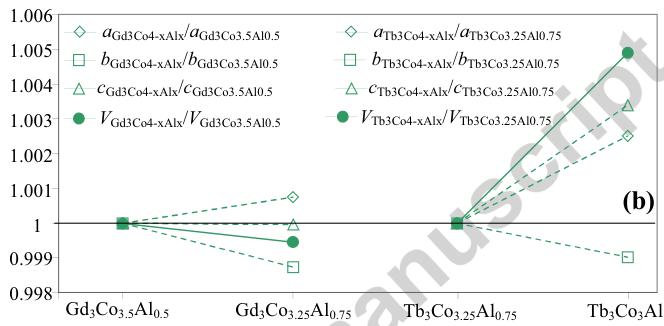
We suggest that \( R_{3}Co_{3.25}Al_{0.75} \) compounds exhibit phase homogeneity of \( R_{3}Co_{4-x}Al_{x} \) (x = 0.5-1) in the R-Co-Al systems as \( Gd_{3}Co_{3.5}Al_{0.5} \) , and \( Tb_{3}Co_{3}Al \) were detected. Within this homogeneous area \( R_{3}Co_{4-x}Al_{x} \) exhibit anisotropic distortion of unit cell vs cobalt (aluminum) content: from \( Gd_{3}Co_{3.5}Al_{0.5} \) to \( Gd_{3}Co_{3.25}Al_{0.75} \) cell parameter a increases, cell parameter c is close to constant, whereas cell parameter b and unit cell volume V decrease; from \( Tb_{3}Co_{3.25}Al_{0.75} to Tb_{3}Co_{3}Al \) cell parameter a and unit cell volume V increase and cell parameters b and c decrease (Table 1).
4.2. Magnetic transitions
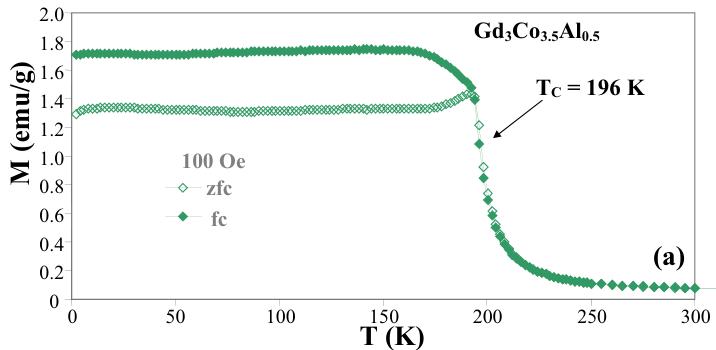
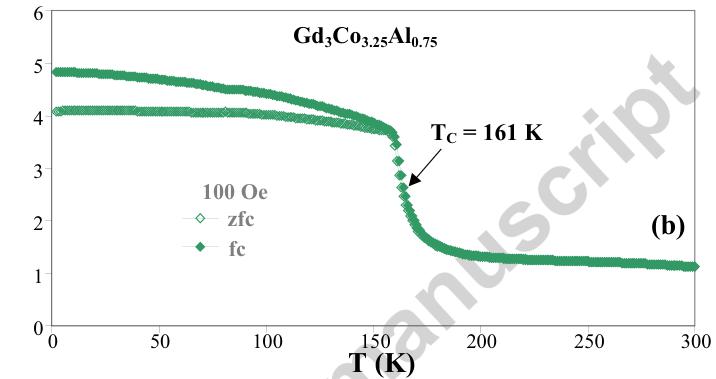
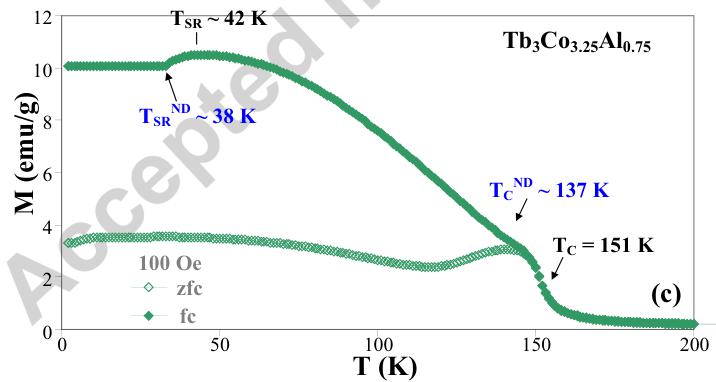
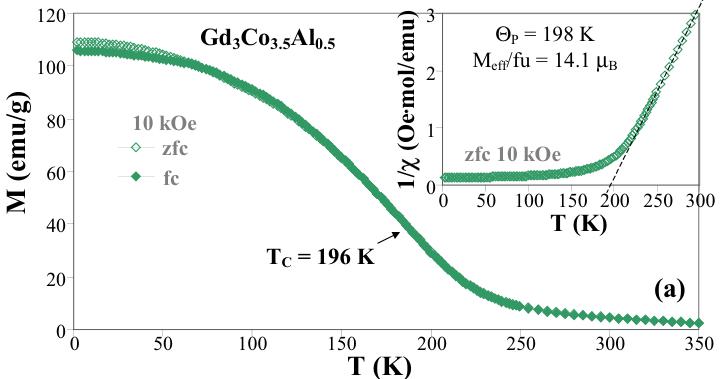
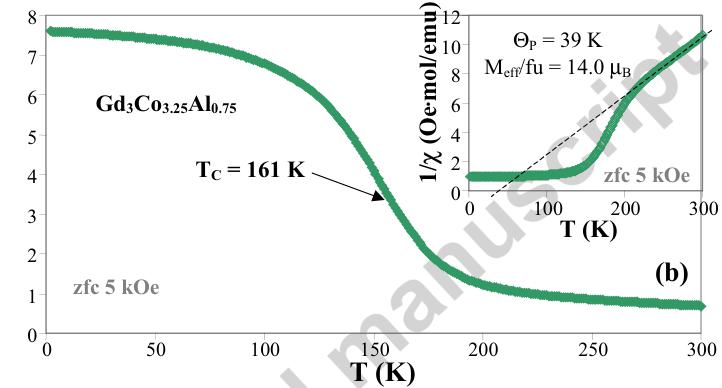
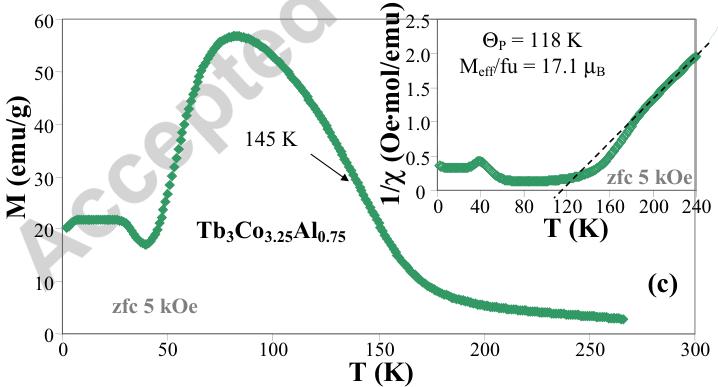
In a field of 100 Oe, \( Gd_{3}Co_{3.5}Al_{0.5} \) ; \( Gd_{3.25}Al_{0.75} \) and \( Tb_{3}Co_{3.25}Al_{0.75} \( exhibit ferrimagnetic transitions at 196 K, 161 K and 151 K, respectively (Figure 1). In contrast with Gd-containing compounds, \) Tb_{3}Co_{3.25}Al_{0.75} \( show a smooth antiferromagnetic-like transition at \) \sim42 \( K. The paramagnetic susceptibility of \) Gd_{3}Co_{3.5}Al_{0.5} \( , \) Gd_{3}Co_{3.25}Al_{0.75} \( and \) Tb_{3}Co_{3.25}Al_{0.75} $ follows the Curie-Weiss law in the temperature range of \( \sim280 \) to 300 K, \( \sim220 \) to 300 K and \( \sim200 \) to 300 K, respectively. The fit to the Curie-Weiss law yields positive paramagnetic Weiss temperatures ) \Theta_{p}=198 \( K for \) Gd_{3}Co_{3.5}Al_{0.5} \(, \) \Theta_{p}= )
39 K for \( Gd_{3}Co_{3.25}Al_{0.75} \) and \( \Theta_{p}=118 \) K for \( Tb_{3}Co_{3.25}Al_{0.75} \) , suggesting dominant ferromagnetic interactions (Figure 2). The effective moments per formula unit, \( M_{eff}/fu \) , are 14.1 \( \mu_{B} \) for \( Gd_{3}Co_{3.5}Al_{0.5} \) , 14.0 \( \mu_{B} \) for \( Gd_{3}Co_{3,25}Al_{0.75} \) and 17.1 \( \mu_{B} \) for \( Tb_{3}Co_{3.25}Al_{0.75,} \) respectively. This suggests that the effective magnetic moments per Co are 1.7 \( \mu_{B} \) , 1.5 \( \mu_{B} \) and 1.7 \( \mu_{B} \) , respectively, assuming that Gd and Tb take the theoretical effective magnetic moment values of 7.94 \( \mu_{B} \) and 9.72 \( \mu_{B} \) , respectively [21]. These values are close to the theoretical cobalt effective magnetic moment of 1.715 \( \mu_{B} \) [21].
4.3. Magnetization
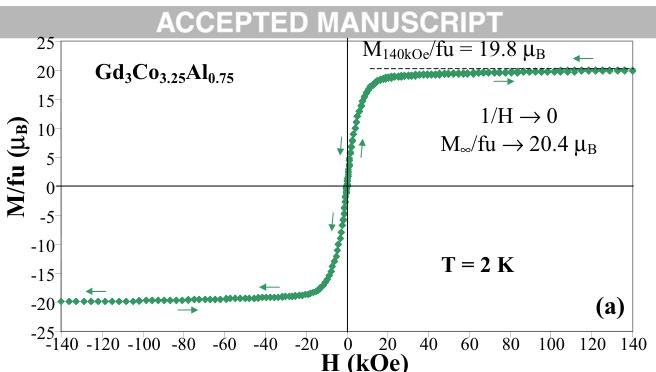
The magnetization vs magnetic field data of \( Gd_{3}Co_{3.25}Al_{0.75} \) , and \( Tb_{3}Co_{3.25}Al_{0.75} \( are plotted in Figure 3. \) Gd_{3}Co_{3.25}Al_{0.75} \( is soft ferrimagnetic down to 2 K with zero residual magnetization and coercive field. At 2 K the magnetization per formula unit of \) Gd_{3}Co_{3.25}Al_{0.75} \( , in field of 140 kOe ( \) M_{140kOe}/fu \( ) reaches value of 19.8 \) \mu_{B} \( (saturation magnetization per formula unit \) M_{\infty}/fu \rightarrow 20.8 ) \mu_{B} \( at \) 1/H \rightarrow 0) (Figure 3a). This value corresponds to magnetization per Gd of ) M_{140kOe}/Gd = 6.6 ) \mu_{B} \( which is close to the theoretical Gd magnetic moment of 7 \( \mu_{B} \) [21], suggesting collinear ferrimagnetic ordering of gadolinium magnetic sublattice in \( Gd_{3}Co_{3.25}Al_{0.75} \) . With insignificant influence of magnetic Co sublattice.
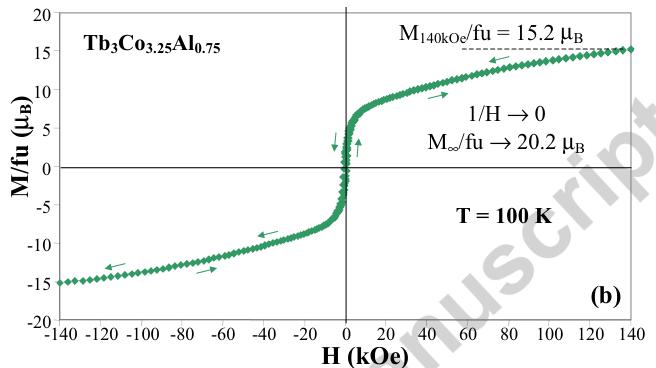
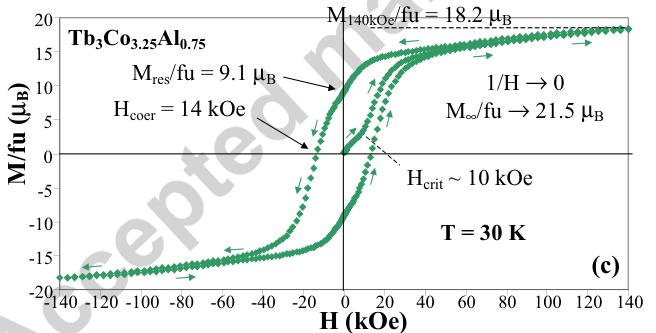
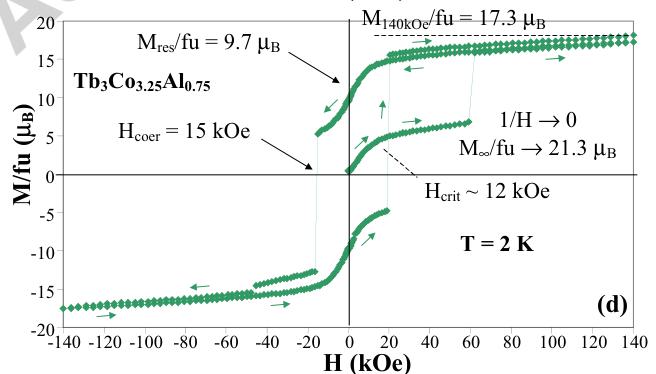
\( Tb_{3}Co_{3.25}Al_{0.75} \) is soft ferrimagnetic below \( T_{C} = 151 \) K and down to the spin-reorientation temperature ( \( T_{SR} \sim 42 \) K in 5 kOe field), e.g., magnetization of \( M_{140kOe}/fu = 15.2 \) \( \mu_{B} \) with zero residual magnetization and coercivity at 100 K (Figure 3b). Below \( T_{SR} \) \( Tb_{3}Co_{3.25}Al_{0.75} \) exhibits permanent magnet properties, such as magnetization of \( M_{140kOe}/fu = 18.2 \) \( \mu_{B} \) , residual magnetization per formula unit ( \( M_{res}/fu \) ) of 9.1 \( \mu_{B} \) , coercive field ( \( H_{coer} \) ) of 14 kOe and critical field ( \( H_{crit} \) ) of \( \sim 10 \) kOe at 30 K (at 30 K \( M_{\infty}/fu \rightarrow 21.5 \) \( \mu_{B} \) ) and \( M_{140kOe}/fu = 17.3 \) \( \mu_{B} \) , \( M_{res}/fu = 9.7 \) \( \mu_{B} \) , \( H_{coer} = 15 \) kOe and \( H_{crit} \sim 12 \) kOe at 2 K ( \( M_{\infty}/fu \rightarrow 21.5 \) \( \mu_{B}\) at 2 K) (Figures 3c and 3d). The magnetization values in 140 kOe indicate noncollinear/incomplete ferrimagnetic ordering of \( Tb_{3}Co_{3.25}Al_{0.75} \) below \( T_{C} \) .
4.4. Magnetocaloric effect (MCE)
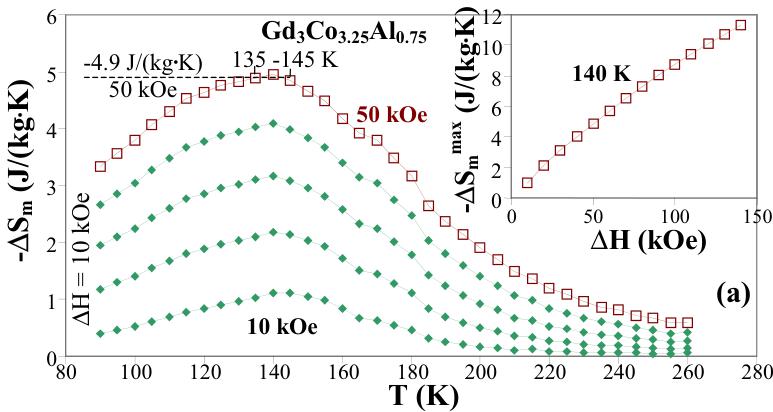
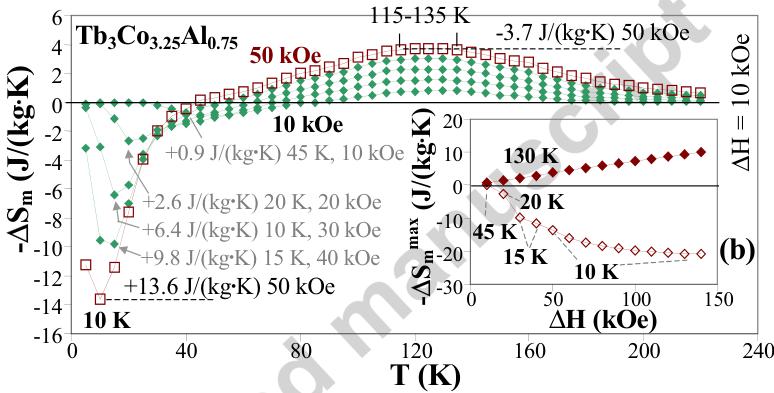
The magnetocaloric effects of \( Gd_{3}Co_{3.25}Al_{0.75} \) and \( Tb_{3}Co_{3.25}Al_{0.75} \) were calculated in terms of the isothermal magnetic entropy change, \( \Delta S_{m} \) , from the magnetization vs field data (Figure 2s).
The magnetocaloric effect of \( Gd_{3}Co_{3.25}Al_{0.75}~ \) around \( \sim140~K \) corresponds to the paramagnetic to ferrimagnetic transition ( \( T_{C}=161~K \) ): the magnetic entropy change, \( \Delta S_{m} \) , reaches a value of \( -4.9~J/kg\cdotK \) for a field change of \( 50~kOe \) at 135-145 K (Figure 4a) and a values of \( -11.3~J/kg\cdotK \) for a field change of \( 140~kOe \) at 125 - 145 K (Figure 3s-a). The maximal magnetic entropy change, \( \Delta S_{m}^{max} \) , at \( 140~K \) shows almost linear dependence vs field change (inserted in Figure 4a).
The magnetocaloric effect of \( Tb_{3}Co_{3.25}Al_{0.75} (\Delta S_{m}) \) reaches a value of -3.7 J/kg·K at 115-135 K and +13.6 J/kg·K at 10 K for a field change of 50 kOe (Figure 4b) and a value of -9.9 J/kg·K at 115-135 K and +32.9 J/kg·K at 5 K for a field change of 140 kOe (Figure 3s-b). The magnetocaloric effect at 115-135 K corresponds to the paramagnetic to ferrimagnetic transition of \( Tb_{3}Co_{3.25}Al_{0.75}\ (T_{C}=151\ K) \) , whereas low-temperature magnetocaloric effect corresponds to the field induced antiferromagnetic transition/spin reorientation or magnetocrystalline anisotropy in \( Tb_{3}Co_{3.25}Al_{0.75} \). The maximum magnetic entropy change, \( \Delta S_{m}^{max} \) , at 130 K shows almost linear dependence, whereas low-temperature \( \Delta S_{m}^{max} \) shows saturated behaviour vs field change with shifting of maxima from 45 K (field change of 0-10 kOe) to 5 K (field change of 0-140 kOe) (inserted in Figure 4b).
The results of magnetization measurements of \( Gd_{3}Co_{3.5}Al_{0.5} \) , \( Gd_{3}Co_{3.25}Al_{0.75} \) , and \( Tb_{3}Co_{3.25}Al_{0.75}} \) are summarized in Table 3. The temperature of magnetic transitions of \( Gd_{3}Co_{3.25}Al_{0.75} and Tb_{3}Co_{3.25}Al_{0.75}} \) does not follow the Gennes rule [21], indicating possible differences in their magnetic structures. If magnetic ordering of \( Tb_{3}Co_{3.25}Al_{0.75}, Dy_{3}Co_{3.25}Al_{0.75} \) and $ Ho_{3}Co_{3.25}Al_{0.75} follows the Gennes rule [21], \( Dy_{3}Co_{3.25}Al_{0.75} \) and Ho_{3}Co_{3.25}Al_{0.75} should exhibit ferromagnetic ordering at 100 K and 65 K and following spin-reorientation transition at 30 K and 20 K, respectively. The increasing of cobalt content in \( \{Tb - Ho\}_{3}Co_{3.25}Al_{0.75}} \) compounds up to \( \{Tb, - Ho\}_{3}Co_{2.5}Al_{0.5}} \) composition should lead to noticeable
increasing of their temperature of ferromagnetic ordering as the Curie temperature of \( Gd_{3}Co_{3.5}Al_{0.5} \) (Tc = 196 K) is significantly bigger than the Curie temperature of \( Gd_{3}Co_{3.25}Al_{0.75} \) ( \( T_{C} = 161 K \) ).
4.5. Neutron diffraction study of \( Tb_{3}Co_{3.25}Al_{0.75} \)
A priori, the magnetic ordering of \( Tb_{3}Co_{3.25}Al_{0.75}} \) may be result of magnetic ordering of Tb and Co in the corresponding atomic positions of unit cell and magnetic structure of \( Tb_{3}Co_{3.25}Al_{0.75)} \) may be viewed as a set of 4c and 8f magnetic terbium and cobalt sublattices with uncertain magnetic ordering of one Co atoms in the 4a site ( \( M = Co_{0.25}Al_{0.75}) \) with uncertain position of Co atom in this site of unit cell (Table 1). For this reason, the only model with magnetic ordering of 4c and 8f magnetic terbium and cobalt sublattices was used for determination of \( Tb_{3}Co_{3.25}Al_{0.75}) \) magnetic structure.
The coordinates for the 4c and 8f sites and symmetry operators of these terbium and cobalt sublattices are given in Table 4.
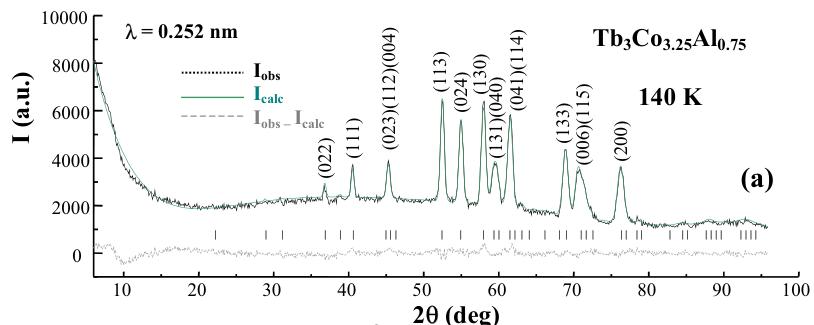
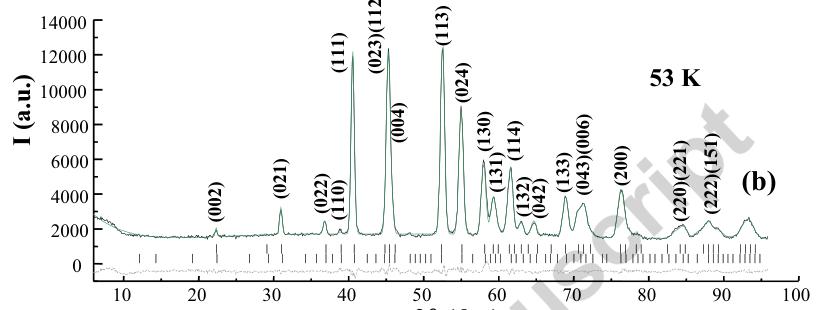
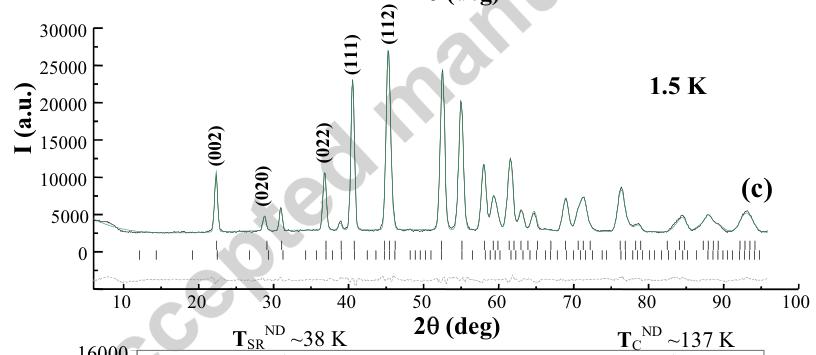
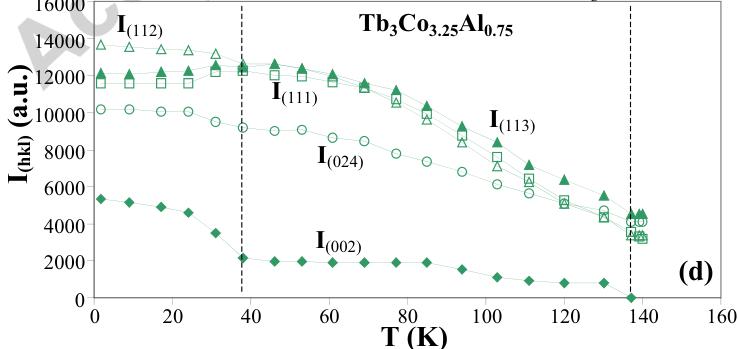
Below \( T_{C}^{ND} \sim 137 \) K, the observed set of magnetic reflections reveals the magnetic ordering of \( Tb_{3}Co_{3.25}Al_{1.75} \) with \( K_{0} = [0, 0, 0] \) wave vector (Figure 5). Thermal variation of structural and magnetic reflections indicates two types of magnetic ordering of \( Tb_{3}Co_{3.25}Al_{0,75} \) : between \( T_{C}^{ND} \sim 137 \) K and \( T_{SR}^{ND} \sim 38 \) K (high-temperature ordering HT) and below \( T_{SR}^{ND} \sim 38 \) K (low-temperature ordering LT) (Figure 5d). The high-temperature magnetic ordering at \( \sim 137 \) K ( \( T_{C}^{ND} \) ) corresponds to the Curie point of \( Tb_{3}Co_{3.25}Al_{0.75,} \) whereas transformation of magnetic scattering at \( \sim 38 \) K ( \( T_{SR}^{ND} \) ) corresponds to the magnetic transition obtained at \( \sim 42 \) K from magnetization measurement.
Analysis of neutron diffraction patterns (NDP) shows that the following variants of commensurate magnetic structure is in the best agreement with experiments:
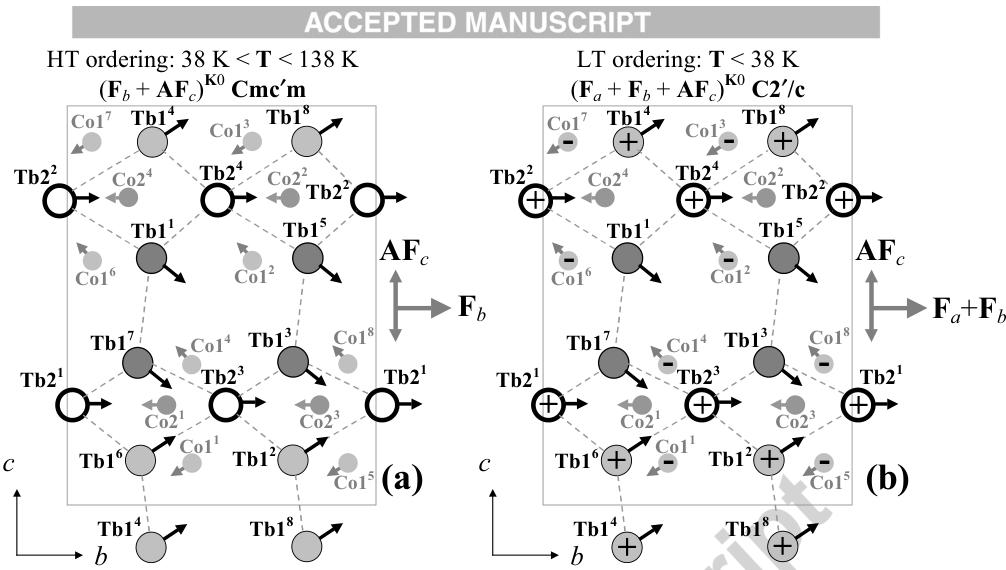
- the Tb1 sublattice is divided for Tb1 \( ^{1,3,5,7} \) and Tb1 \( ^{2,4,6,8} \) sublattices with different orientation of magnetic moments; the Co1 sublattice is divided for Co1 \( ^{1,3,5,7} \) and Co1 \( ^{2,4,6,8} \) sublattices with different orientation and magnetic moments, whereas Tb2 (Tb2 \( ^{1,2,3,4} \) ) and Co2 (Co2 \( ^{1,2,3,4} \) ) sublattices show same magnetic ordering for terbium and cobalt atoms, respectively;
-
the \( Tb^{1,3,5,7} \) and \( Co^{1,3,5,7} \) , \( Tb^{1,2,4,6,8} \) and \( Co^{1,2,4,6,8} \) , \( Tb^{2,1,2,3,4} \) and \( Co^{2,1,2,3,4} \) sublattices exhibit antiferromagnetic ordering;
-
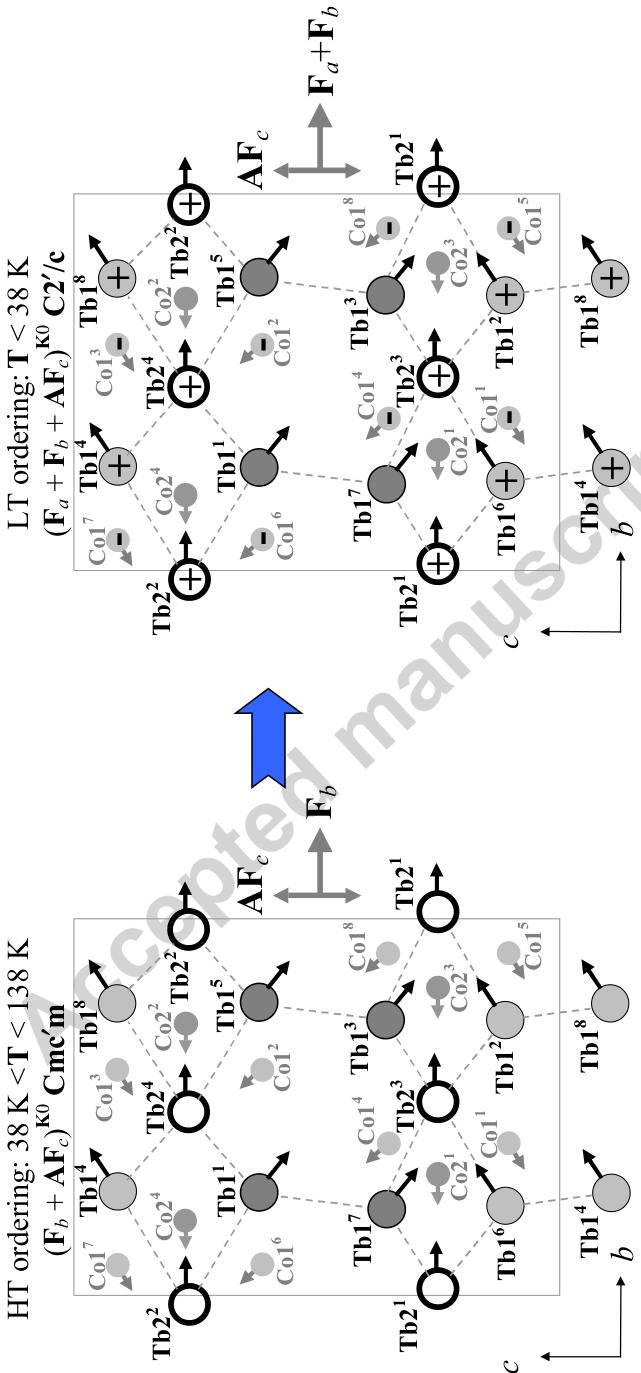
between ~137 K and 38 K the mixed b-axis ferromagnetic (ferrimagnetic) \( \mathbf{F}_{b} = [\mathbf{F}_{b}(\mathrm{Tb}) - \mathbf{F}_{b}(\mathrm{Co})] \) and c-axis antiferromagnetic (anti-ferrimagnetic) \( \mathbf{AF}_{c} = [\mathbf{AF}_{c}(\mathrm{Tb}) - \mathbf{AF}_{c}(\mathrm{Co})] \) ordering of \( Cmc'm = \{1, m_{x}\} \times \{1, m_{z}/[0, 0, 1/2]\} \times \{1, i'\} \times \{1, 1/[1/2, 1/2, 0]\} \) magnetic space group (N 63.4.514) [18]: \( (\mathbf{F}_{b} + \mathbf{AF}_{c})^{\mathrm{K0}} \) \( Cmc'm \) (Table 5 and Figure 6a);
-
below 38 K the resulting mixed ab-axis ferromagnetic (ferrimagnetic) \( (\mathbf{F}_{a} + \mathbf{F}_{b}) = [\mathbf{F}_{a}(\mathrm{Tb}) - \mathbf{F}_{a}(\mathrm{Co}) + \mathbf{F}_{b}(\mathrm{Tb}) - \mathbf{F}_{b}(\mathrm{Co}]) \) and c-axis antiferromagnetic (anti-ferrimagnetic) \( \mathbf{Af}_{c} = [\mathbf{AF}_{c}(\mathrm{Tb}) - \mathbf{A}\mathbf{F}_{c}(\mathrm{Co})] \) ordering of \( C2'/\mathbf{c} = \{1, m_{z}/[0, 0, 1/2]\} \) \( \times \{1, i'\} \times \{1, 1/[1/2,\ 1/2,\ 0]\} \) magnetic space group (N 15.3.94) [18]: \( (\mathbf{F}_{a} + \mathbf{F}_{b} + \mathbf{AF}_{c})^{\mathrm{K0}} \) C2'/c (Table 5 and Figure 6b).
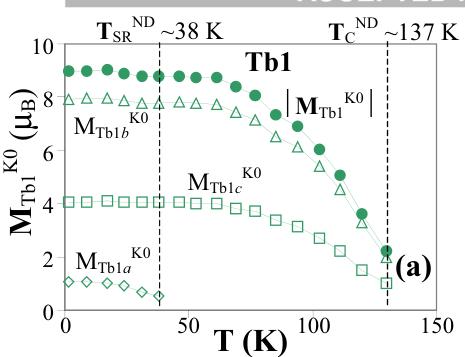
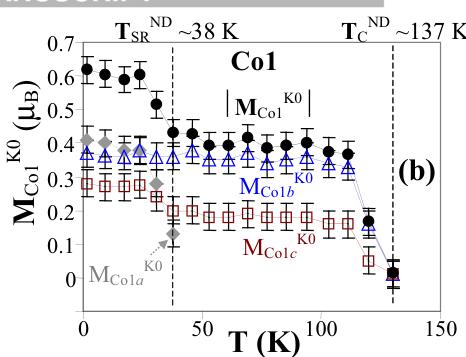
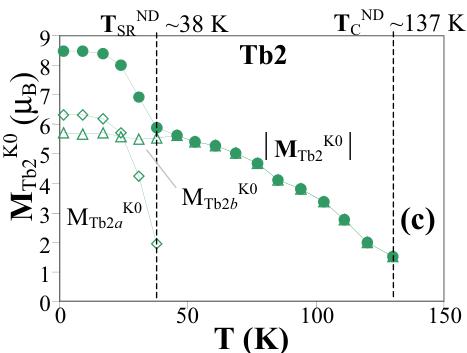
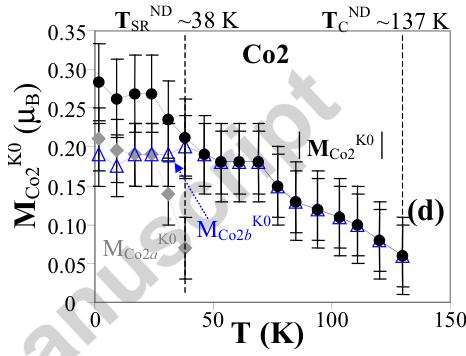
Thermal variation of a-, b-, c-axis magnetic components and resulting magnetic moment of corresponding Tb1, Tb2, Co1 and Co2 atoms are given in Figures 7a-d. At 1.5 K the magnetic moments of terbium and cobalt reach values of \( M_{Tb1} = 9.0 \mu_{B} \) , \( M_{Tb2} = 8.5 \mu_{B} \) , \( M_{Co1} = 0.62 \mu_{B} \) and \( M_{Co2} = 0.28 \mu_{B} \) (Table 5). The magnitude of terbium magnetic moment is close to the theoretical Tb magnetic moment of \( 9 \mu_{B} \) [21], whereas cobalt magnetic moment is less than the elemental cobalt magnetic moment of \( 1.7 \mu_{B} \) [21]. The remarkably small Co atomic moments refined in \( Tb_{3}Co_{3.25}Al_{0.75} \) can be explained by their peculiar local atomic environment. As was previously discussed elsewhere, the short Co-Al bounding plays in favor of a reduction of the Co magnetic moment magnitude as a result of the electronic shell hybridization with the metalloid. Such interpretation has been revealed by neutron diffraction upon substitution of Al for Co in \( RCo_{5} \) compounds [22, 23] and later confirmed both experimentally by X-ray photoemission spectroscopy (XPS) and theoretically by electronic structure calculations [24, 25]. XPS measurements have shown that the hybridization between the rare-earth 5d6s and Al 3sp and 4sp states and Co 3d states leads to a partial filling of the Co 3d band and to a decrease of the Co magnetic moments in comparison with the value in pure Co metal. The Co1 position has an
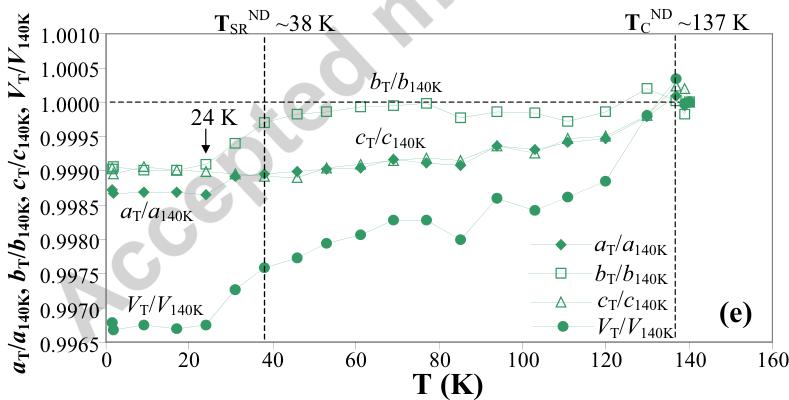
average of 1.5 Al as nearest neighbours. For the Co2 position, the even smaller magnetic moment obtained in the \( Tb_{3}Co_{3.25}Al_{0.75} \) originates from the Tb rich environment since seven out of the nine near neighbors are Tb ones. Indeed the R-Co bounds are known to promote the reduction of the Co magnetic moment by electronic effect on the Co 3d band, a feature already reported in R-Co binaries [26] where the Co magnetic moment can even vanish for the high R concentrations. The increasing of magnetic moments of Tb2, Co1 and Co2 sublattices at the spin-orientation transition indicates the crucial role of these magnetic sublattices in the low-temperature ordering of \( Tb_{3}Co_{3.25}Al_{0.75} $ . The unit cell of \( Tb_{3}Co_{3.25}Al_{0.75}} \) undergoes anisotropic compression: below the ferromagnetic transition \( \Delta a/a_{140K} \approx \Delta c/c_{140K} < \Delta b/b_{140K} \) , below spin-reorientation transition (at 24 K) \( \Delta a/a_{140K} < \Delta c/c_{140K} \approx \Delta b/b_{140K} \) and below 24 K the \( \Delta a/a_{140K} \) , \( \Delta b/b_{140K} \) , \( \Delta c/c_{140K} \) and \( \Delta V/V_{140K} \) relative parameters are close to constant (Figure 7e). At 1.5 K the \( \Delta a/a_{140K} \) , \( \Delta b/\Delta b_{140K} \) and \( \Delta c/c_{140K} \) reach the values of -0.00128, -0.00098 and -0.00096, respectively, whereas \( \Delta V/V_{140K} = -0.00322 \) . Such behavior of the lattice parameters is clearly related to magnetic ordering and indicates magnetovolume correlations.
5. Discussion
As shown in Bilbao Crystallographic Server [12], Cmcm space group may be given in Pnma, Pmmn, Pnnm, Pnna, Pmma, Pbcm, Pbcn, Cmc2 \( _{1} \) , Amm2, Ama2, C222 \( _{1} \) , C2/c, C2/m and P2 \( _{1} \) /m maximal subgroups in different axis and Cmcm group may be viewed as a maximal subgroup of hexagonal P6 \( _{3} \) /mmc group. The W \( _{3} \) CoB \( _{3} \) -type unit cell (type structure) [14, 27] may be given in term of Pnma, Pbcn, Pbcm, Pnna, Ama2, C222 \( _{1} \) , C2/c and P2 \( _{1} \) /m space groups corresponding to possible distortion of lattice and W \( _{3} \) CoB \( _{3} \) -type unit cell may be described in term of Pnma, Pnnm, Pmmn, Pnma, Amm2, Cmc2 \( _{1} \) and C2/m space groups with distortion and destruction of some initial sublattice on the two sublattices as shown in Figure 4s. These modifications of W \( _{3} \) CoB \( _{3} \) -type lattice may be observed in solid solution based on the R \( _{3} \) T \( _{4-x} \) X \( _{x} \) compounds, they may be obtained at various synthesis conditions,
due to magnetic ordering of \( W_{3}CoB_{3} \) -type lattice or structural transformation of lattice and different temperatures. Meanwhile, from the known structural types, the \( La_{3}Ni_{2}Ga_{2} \) -type (Pbcm, N 57, oP28) [27], \( Gd_{3}NSe_{3} \) -type [28], \( NdRh_{2}Sn_{4} \) -type [27, 29] and \( Sm_{2}NiSn_{4} \) -type [27, 30] (Pnma, N 62, oP28), \( Ce_{3}Pd_{6}Sb_{5} \) -type (Pmmn, N 59, oP28) [27, 31], \( Er_{8}Si_{17}B_{3} \) -type ( \( Cmc_{21} \) , N 36, oC28) [27, 32] and \( Sc_{3}NiSi_{3} \) -type (C2/m, N 12-2, mC28) [27, 33] structures may be viewed as structural derivatives of initial \( W_{3}CoB_{3} \) -type structure [14, 27].
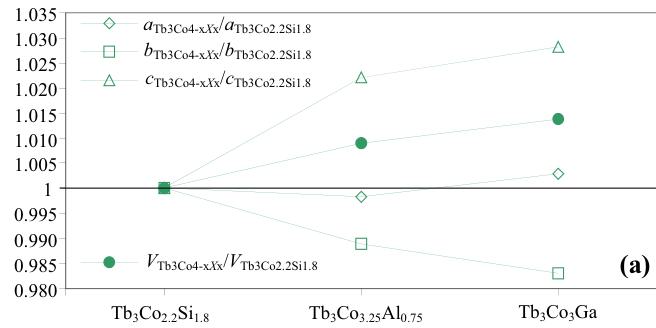
The replacing of Si for Al and Ga in the \( Tb_{3}Co_{2.2}Si_{1.8} \) [5, 8] - \( Tb_{3}Co_{3.25}Al_{0.75} \) - \( Tb_{3}Co_{3}Ga \) [6]' row leads to anisotropic distortion of initial \( Tb_{3}Co_{2.2}Si_{1.8} \( unit cell with increasing of c cell parameter and unit cell volume V and decreasing of b cell parameters, whereas a cell parameter is close to constant in this row (Figure 8a). The cell parameters in the \) R_{3}Co_{2.2}Si_{1.8} \( [5, 8] - \) R_{3}Co_{3.25}Al_{0.75} \( - \) R_{3}Co_{3}Ga ) [6]' rows (R = Y, Gd, Dy-Ho) show same behaviour (see Table 1).
The distortion of unit cell and changes in the Co sublattices from \( Tb_{3}Co_{2.2}Si_{1.8} [5, 8] \) to \( Tb_{3}Co_{3.25}Al_{0.75} \) determine the difference in their magnetic ordering (see Tables 3 and 5):
-
in spite of expansion of unit cell, temperature of ferrimagnetic ordering of \( Tb_{3}Co_{3.25}Al_{0.75} (T_{C} = 151\ K) \) is larger than the Curie point of \( Tb_{3}Co_{2.2}Si_{1.8} (T_{C} = 132\ K [5]) \) due to increasing of Co content and change in Co sublattices;
-
\( Tb_{3}Co_{3.25}Al_{0.75} and Tb_{3}Co_{2.2}Si_{1.8} \) show similar high-temperature magnetic ordering: same \( (\mathbf{F}_{b} + \mathbf{A}\mathbf{F}_{c})^{\mathbf{K}\mathbf{U}} \) Cmc'm commensurate component (in contrast to \( Tb_{3}Co_{2.2}Si_{1.8} \) , the magnetic ordering of Co sublattices suppresses the incommensurate antiferromagnetic component in \( Tb_{3}Co_{3.25}Al_{0.75} \) ) with soft ferromagnetic properties;
-
\( Tb_{3}Co_{3.25}Al_{_{0.75}} \) and \( Tb_{3}Co_{2.2}Si_{_{1.8}} \) show low-temperature spin-reorientation ordering with additional a-axis ferromagnetic component and low-temperature permanent magnet properties, but with different low-temperature magnetic structures.
The following expansion of unit cell from \( Tb_{3}Co_{3.25}Al_{0.75} to Tb_{3}Co_{3}Ga \) may lead to decreasing of ferromagnetic interactions in \( Tb_{3}Co_{3}Ga \) , decreasing of temperature of ferrimagnetic ordering with
similar magnetic structure and magnetic ordering of \( Tb_{3}Co_{3}Ga \) and \( Tb_{3}Co_{3.25}Al_{0.75} \) : high-temperature soft ferromagnetic properties and low-temperature permanent magnet properties due to spin-reorientation transition.
The high-temperature ferrimagnetic-type ordering corresponds to the negative magnetic entropy change, whereas low-temperature spin-reorientation ordering (rotation of ferromagnetic component) determines positive \( \Delta S_{m} \) value for polycrystalline \( Tb_{3}Co_{3.25}Al_{0.75} \( , namely. Within homogeneity area the \( Gd_{3}Co_{3.5}Al_{0.5} \) - \( Gd_{3}Co_{3.25}Al_{0.75} \) and \( Tb_{3}Co_{3.25}Al_{0} \) - \( Tb_{3}Co_{3}Al' \) compounds show slight anisotropic distortion of unit cell (Figure 8b). Thus, the change in Co sublattices from \( Gd_{3}Co_{3.25}Al_{0.75} \) to \( Gd_{3}Co_{3.5}Al_{0.5} \) is the main reason for increasing of Curie point from 161 K in \( Gd_{3}Co_{3.25}Al_{0.75} \) up to 196 K in \( Gd_{3}Co_{3.5}Al_{0.5} \) : the set of isolated Co atom with uncertain position and with uncertain magnetic ordering in \( 4a\ M = Co_{0.25}Al_{0.75} \) sublattice of \( Gd_{3}Co_{3.25}Al_{0.75} \) transforms in to the additional magnetic Co sublattice in the \( M = Co_{0.5}Al_{0.5} \) site of \( Gd_{3}Co_{3.5}Al_{0.5} \) .
Thus, the type of rare earth, transition metal and p-element sublattices determine the distortion level of \( W_{3}CoB_{3} \) -type lattice and magnetic ordering of \( R_{3}Co_{4-x}Al_{x} \) (x = 0.5...1) compounds with magnetic rare earth and cobalt sublattices.
6. Conclusion
The \( \{Y, Gd - Ho\}_{3}Co_{3.25}Al_{0.75} \) , \( Gd_{3}Co_{3.5}Al_{0.5} \) , and \( Tb_{3}Co_{3}Al \) compounds supplement the series of \( W_{3}Co_{3}B \) -type rare earth compounds. They show ferrimagnetic ordering and they exhibit homogeneity area \( R_{3}Co_{3\ldots3.5}Al_{1\ldots0.5} \) in corresponding ternary R-Co-Al system with transformation of magnetic Co sublattice and magnetic ordering. Large Tb magnetic moment close to the expected trivalent state is observed at low temperature in \( Tb_{3}Co_{3.25}Al_{0.75}w \) while small magnetic moment of Co is obtained on both cobalt positions as a result of the strong chemical bonds with the Al and Tb nearest neighbours.
Acknowledgments
This work is supported by Russian Fund for Basic Research through the project N° 16-03-00666-a and the National Natural Science Foundation of China (Grant No. 51301116), the 333 Project, the Six-Summit Project of Jiangsu (Grant No. 2013-XCL-038). SKM thanks CAPES, Brazil for the award of a fellowship. The Institute Laue Langevin is warmly acknowledged for the use of the neutron diffraction beamtime as well as the CRG-instruments. The unit cell data of \( Gd_{3}Co_{3.5}Al_{0.5} \) used with permission - © JCPDS - International Centre for Diffraction Data. A.V. Garshev and A.V. Knotko acknowledge partial support from M.V. Lomonosov Moscow State University Program of Development. R. N thanks DST-RFBR for support.
References
[1] P. Schobinger-Papamantellos, O. Oleksyn, C. Ritter, C. H. de Groot, K. H. J. Bushcow, J. Magn. Magn. Mater. 169 (1997) 253–260.
[2] Y. Y. Chen, Y. D. Yao, Y. S. Lin, C. L. Chang, H. H. Hamdeh, J. C. Ho, Phys. Rev. B 61 (2000) 58.
[3] O.I. Bodak, O.Y. Oleksin, M.F. Fedyna, V.K. Pecharskii, Inorg. Mater. 28 (1992) 371–374.
[4] E. Gaudin, C. Mayer, F. Weill, B. Chevalier, J. Alloys Compd. 545 (2012) 148–152.
[5] A.V. Morozkin, J. Yao, Y. Mozharivskyj, J. Solid State Chem. 192 (2012) 371–376.
[6] Y.P. Yarmolyuk, Y. Grin, E.I. Gladyshevskii, Dopov. Akad. Nauk Ukr. RSR, Ser. A (1978) 855–858 (In Russian).
[7] J. Yao, A. V. Morozkin, Y. Mozharivskyj, J. Alloys Compd. 550 (2013) 331–334.
[8] A.V. Morozkin, O. Isnard, R. Nirmala, S.K. Malik, J. Magn. Magn. Mater. 389 (2015) 157–168
[9] www.ill.eu, Yellow Book
[10] F. Izumi, "The Rietveld Method," ed. by R.A. Young, Oxford University Press, Oxford (1993) 13.
[11] F. Izumi, The Rigaku Journal 6(1) (1989) 10-20.
[12] Bilbao Crystallographic Server [The crystallographic site at the Condensed Matter Physics Dept. of
the University of the Basque Country], http://www.crys.ehu.es.
[13] International Tables for crystallography vol. A (2016), John Wiley and Sons Inc. New York, DOI: 10.1107/9780955360206000001.
[14] O.Ya. Oleksyn, O.I. Bodak, J. Alloys Compd. 210 (1994) 19–21.
[15] R.A. Levy. Principles of Solid State Physics, Academic Press, NY USA 1968.
[16] A.M. Tishin, Y.L. Spichkin, The Magnetocaloric Effect and Its Applications, Institute of Physics Publishing, Bristol, Philadelphia (2003) 480.
[17] J. Rodriguez-Carvajal, Physica B 192 (1993) 55-69.
[18] D. B. Litvin, Magnetic Group Tables, 1-, 2- and 3-Dimensional Magnetic Subperiodic Groups and Magnetic Space Groups,, International Union of Crystallography, 2013 ISBN 978-0-9553602-2-0 doi:10.1107/9780955360220001. Reviewed by the IUCr Commission on Magnetic Structures.
[19] J. Emsley, The elements. Second edition, Clarendon press – Oxford (1991).
[20] Fizicheskie velichiny (Physical Data). Handbook, Ed. by I.S.Grigor'ev, E.Z.Meilohov, Moscow, Energoatomizdat, 1994 (In Russian).
[21] S. Legvold, Rare Earth Metals and Alloys, Ferromagnetic Materials, Ed. by P. Wohlfarth, Amsterdam, North-Holland Publ. Co. (1980) 183–295.
[22] C. Zlotea, O. Isnard, J. Phys.: Condens. Matter. 14 (2002) 10211-10220.
[23] C. Zlotea, O. Isnard, J. Magn. Magn. Mater. 253 (2002) 118-129.
[24] A. Laslo, R. Dudric, M. Neumann, O. Isnard, M. Coldea, V. Pop, Solid State Commun. 199 (2014) 43-46.
[25] D. Benea, O. Isnard, N. Coroian, V. Pop, J. Magn. Magn. Matter. 322 (2010) 1052-1055.
[26] D. Gignoux, D. Schmitt, J. Magn. Magn. Matter. 100 (1991) 99-125.
[27] Springer Materials The Landolt-Börnstein Database - Materials Science Data for 250000 Substances, http://www.springermaterials.com.
[28] C. M. Schurz, P. Talmon-Gros, F. Lissner, T. Schleid, Solid State Sciences 17 (2013) 140-145.
[29] M. Meot-Meyer, G. Venturini, B. Malaman, B. Roques, Mater. Res. Bull. 20 (1985) 913–919.
[30] Z.M. Sun, D.C. Pan, X.W. Lei, J.G. Mao, J. Solid State Chem. 179 (2006) 3378–3384.
[31] R.A. Gordon, F.J. DiSalvo, R. Pöttgen, J. Alloys Compd. 228 (1995) 16–22.
[32] R. Jardin, V. Babizhetskyy, R. Guérin, J. Bauer, J. Alloys Compd. 353 (2003) 233–239.
[33] B.Ya. Kotur, E.I. Gladyshevskii, Sov. Phys. Crystallogr. 28 (1983) 271 (In Russian).
Figure 1. Magnetization as a function of temperature in field of 100 Oe of (a) \( Gd_{3}Co_{3.5}Al_{0.5} \) , (b) \( Gd_{3}Co_{3.25}Al_{0.75} \) and (c) \( Tb_{3}Co_{3.25}Al_{0.75} \) (temperature of magnetic transitions from neutron diffraction study inserted into Figure c).
Figure 2. Magnetization vs temperature of (a) \( Gd_{3}Co_{3.5}Al_{0,5} \) in field of 10 kOe, (b) \( Gd_{3}Co_{3.25}Al_{0.7,5} \) and (c) \( Tb_{3}Co_{3.25}A1_{0.75} \) in field of 5 kOe (paramagnetic susceptibility vs temperature inserted into Figures).
Figure 3. Magnetization vs magnetic field from -140 kOe to 140 kOe of (a) \( Gd_{3}Co_{3.25}Al_{0.75} at 2 K \) and \( Tb_{3}Co_{3.25}Al_{0.75} at (b) 100 K \) , (c) 30 K and (d) 2 K
Figure 4. The isothermal magnetic entropy change \( -\Delta S_{m} \) , vs temperature for a field changes of 0-50 kOe of (a) \( Gd_{3}Co_{3.25} \) \( Al_{0.75} \) and (b) \( Tb_{3}Co_{3.25} \) \( Al_{0.75} \) , (maximal value of magnetic entropy change \( -\Delta S_{m}^{max} \) at corresponding temperature vs field change inserted into Figures).
Figure 5. Neutron diffraction patterns of \( Tb_{3}Co_{3.25}Al_{0.75}:(a) \) at 140 K (paramagnetic state), (b) at 53 K (high-temperature magnetic ordering HT), (c) at 1.5 K (low-temperature magnetic ordering LT) and (d) thermal variation of some reflections. The first and second rows of ticks refer to the nuclear Bragg peaks and magnetic reflections of \( Tb_{3}Co_{3.25}Al_{0.75}, \) respectively in Figures a-c. Only magnetic
reflections are marked in Figure b. The strongest magnetic reflections of low-temperature magnetic ordering are marked in Figure c.
Figure 6. Image of magnetic structure of \( Tb_{3}Co_{3.25}Al_{0.75} \) (a) between \( \sim137 \) K and 38 K and (b) below 38 K (projection on the bc plane), The shortest Tb1-2Tb1, Tb1-1Tb2 and Tb1-2Tb2 distances are shown in Figures (see Table 2).
Figure 7. Thermal evolution of magnetic moments of (a) Tb1, (b) Co2, (c) Tb2 and (d) Co2 sublattices and (e) relative cell parameters of \( Tb_{3}Co_{3.25}Al_{0.75}. \)
Figure 8. Relative cell parameters of (a) \( Tb_{3}Co_{2.25}Si_{1.8} \) [3, 6] - \( Tb_{3}Co_{3.25}Al_{0.75} - Tb_{3}Co_{3}Ga \) [4]' row and (b) \( Gd_{3}Co_{3.5}Al_{0.5} - Gd_{3}Co_{3.25}Al_{0.75} \) and \( Tb_{3}Co_{3.25}Al_{0.75} = Tb_{3}Co_{3}Al' \) rows.
Table 1.
Unit cell data of the \( W_{3}CoB_{3} \) -type \( R_{3}Co_{4-x}Al_{x} \) (x = 1...0.5, R = Y, Gd - Ho) compounds, space group \( Cmcm \) , N 63, oC28. The unit cell data of \( \{Gd - Dy\}_{3}Co_{2.25}Si_{1.8} \) [5, 8] and \( \{Gd, Tb\}_{3}Co_{3}Ga \) [6] are given for comparison.
| Compound | a (nm) | b (nm) | c (nm) | V (nm3) | d (g/cm3) | RF (%) | Refs. |
| Y3Co3.25Al0.75 | 0.40910(6) | 1.01726(18) | 1.29336(24) | 0.53825 | 5.9047 | 5.5 | a- |
| Gd3Co3.5Al0.5b,c | 0.41093(1) | 1.02026(2) | 1.30794(3) | 0.54836 | 8.3760 | 2.5 | a- |
| Gd3Co3.25Al0.75 | 0.41124(3) | 1.01897(8) | 1.30789(11) | 0.54806 | 8.2838 | 6.3 | a- |
| Tb3Co3.25Al0.75d | 0.40895(3) | 1.01301(5) | 1.29909(7) | 0.53817 | 8.4980 | 4.1 | a- |
| Tb3Co3Al | 0.40998(3) | 1.01199(9) | 1.30349(12) | 0.54081 | 8.3584 | 6.5 | a- |
| Dy3Co3.25Al0.75 | 0.40790(2) | 1.00837(6) | 1.29593(8) | 0.53303 | 8.7136 | 4.9 | a- |
| Ho3Co3.25Al0.75 | 0.40705(3) | 1.00514(8) | 1.29352(11) | 0.52923 | 8.8676 | 4.8 | a- |
| Gd3Co2.2Si1.8 | 0.41229 | 1.0308 | 1.2793 | 0.54369 | 7.9648 | [5] | |
| Tb3Co2.2Si1.8 | 0.40967 | 1.02439 | 1.27102 | 0.53340 | 8.1810 | [8] | |
| Dy3Co2.2Si1.8 | 0.40828 | 1.01898 | 1.26913 | 0.52800 | 8.3997 | [8] | |
| Gd3Co3Ga | 0.4119 | 1.0080 | 1.3140 | 0.54557 | 8.7448 | [6] | |
| Tb3Co3Ga | 0.4109 | 1.0070 | 1.3070 | 0.54081 | 8.8835 | [6] |
\( ^{a} \) this work;
\( ^{b} \) Crystallographic data used with permission of JCPDS - International Centre for Diffraction Data;
\( ^{c} \) Gd \( _{3} \) Co \( _{3.5} \) Al \( _{0.5} \) : Gd1 8f [0, 0.2872(2), 0.6049(2)], Gd2 4c [0, 0.0064(1), 1/4], Co1 8f [0, 0.4276(3), 0.0884(2)], Co2 4c [0, 0.3020(6), 1/4], M = Co \( _{0.5} \) Al \( _{0.5} \) 4a [0, 0, 0], atomic displacement parameters of all atoms \( \beta_{11} = 0.014805 \) , \( \beta_{22} = 0.002402 \) , \( \beta_{33} = 0.001461 \) ( \( \beta_{11} = B_{11}/[2a]^{2} \) , \( \beta_{22} = B_{11}/[2b]^{2} \) , \( \beta_{33} = B_{33}/[2c]^{2} \) );
\( ^{d} \) \( Tb_{3}Co_{3.25}Al_{0.75} \) : Tb1 (8f) [0, 0.2863(3), 0.6047(2)], Tb2 (4c) [0, 0.0025(5), 1/4], Co1 (8f) [0, 0.4246(7), 0.0902(5)], Co2 (4c) [0, 0.3019(11), 1/4], M (4a) [0, 0, 0], M = Co \( _{0.25} \) Al \( _{0.75} \) , atomic displacement parameters of all atoms \( \beta_{11} = 0.014949 \) , \( \beta_{22} = 0.002436 \) , \( \beta_{33} = 0.001481 \) ( \( \beta_{11} = B_{11}/[2a]^{{2}} \) , \( \beta_{22} = B_{11}/[2b]^{{2}} \) , \( \beta_{33} = B_{33}/[2c]^{{2}} \) ).
Table 2. Interatomic distances of \( W_{3}CoB_{3} \) -type \( Tb_{3}Co_{3.25}Al_{0.75} \) (ESD ±0.0004): space group \( Cmcm \) , N 63, \( a = 0.40895(2) \) nm, \( b = 1.01301(5) \) nm, \( c = 1.29909(7) \) nm, Z = 4, Tb1 (8f) [0, 0.2863(3), \( 0.6047(2) \) ], Tb2 (4c) [0, 0.0025(5), \( 1/4 \) ], Co1 (8f) [0, 0.4246(7), \( 0.0902(5) \) ], Co2 (4c) [0, 0.3019(11), \( 1/4 \) ], M (4a) [0, 0, 0], M = \( Co_{0.25}Al_{0.75} \) , \( R_{F} = 4.1\% \) . \( ^{a} \) In the Table are given the ratio of interatomic distances to the sum of the atomic radii of the corresponding atoms \( \Delta \) ( \( r_{Tb} = 0.17788 \) nm, \( r_{Co} = 0.1251 \) nm, \( r_{Al} = 0.14317 \) nm and for M atom the \( r_{M} = 0.25r_{Co} + 0.75r_{Al} \) ) [19, 20] \( \Delta = D/(R_{atom1} + R_{atom2}) \) and coordination numbers CN. The shortest Tb-Tb, Tb-Co and Co-Co distances are selected by a boldface character.
| Atom | -Atom | D (nm) | \( \Delta \) | Atom | -Atom | D (nm) | \( \Delta \) |
| Tb1 | -1Co1 | 0.28937 | 0.96 | Co1 | -1Co2 | 0.24196 | 0.97 |
| 2Co2 | 0.29227 | 0.96 | 2M | 0.24774 | 0.94 | ||
| 1Co1 | 0.29347 | 0.97 | 1Co1 | 0.27975 | 1.12 | ||
| 2Co1 | 0.29633 | 0.98 | 1Tb1 | 0.28937 | 0.96 | ||
| 1M | 0.32033 | 1.01 | 1Tb1 | 0.29347 | 0.97 | ||
| 2M | 0.32737 | 1.03 | 2Tb1 | 0.29633 | 0.98 | ||
| 2Tb1 | 0.34816 | 0.98 | 2Tb2 | 0.30188 | 1.00 | ||
| 1Tb2 | 0.34817 | 0.98 | CN = 10 | ||||
| 2Tb2 | 0.35102 | 0.99 | |||||
| 1Tb1 | 0.37752 | 1.06 | Co2 | -2Co1 | 0.24196 | 0.97 | |
| CN = 15 | 2Tb2 | 0.28828 | 0.95 | ||||
| 4Tb1 | 0.29227 | 0.96 | |||||
| Tb2 | -2Co2 | 0.28828 | 0.95 | 1Tb2 | 0.30330 | 1.00 | |
| 4Co1 | 0.30188 | 1.00 | CN = 9 | ||||
| 1Co2 | 0.30330 | 1.00 | M | -4Co1 | 0.24774 | 0.94 | |
| 2M | 0.32478 | 1.03 | 2Tb1 | 0.32033 | 1.01 | ||
| 2Tb1 | 0.34817 | 0.98 | 2Tb2 | 0.32478 | 1.03 | ||
| 4Tb1 | 0.35102 | 0.99 | 4Tb1 | 0.32737 | 1.03 | ||
| CN = 15 | \( \delta = 12 \) |
Table 3.
Magnetic properties of \( W_{3}CoB_{3} \) -type \( \{Gd - Ho\}_{3}Co_{3.25}Al_{0.75} \) and \( Gd_{3}Co_{3.5}Al_{0.5} \) compounds: effective magnetic moment per formula unit ( \( M_{eff}/fu \) ) and per Co ( \( M_{eff}/Co \) ) (assuming that rare earths take the theoretical effective moment values [21]), paramagnetic Weiss temperature ( \( \Theta_{p} \) ), Curie point ( \( T_{C} \) ), temperature of spin reorientation transition ( \( T_{SR} \) ), magnetization per formula unit in field of 140 kOe ( \( M_{140kOe}/fu \) ), remanent magnetisation per formula unit ( \( M_{res}/fu \) ), coercive field ( \( H_{coer} \) ), critical field ( \( H_{crit} \) ) and magnetocaloric effect (MCE) in terms of isothermal magnetic entropy change, \( \Delta S_{m} \) , for a field change of 0-50 kOe and 0-140 kOe. Magnetic properties of \( Tb_{3}Co_{2.2}Si_{1.8} \) [8] are given for comparison.
| Compound | M_{eff}/fu (\mu_{B}) | M_{eff}/Co (\mu_{B}) | \Theta_{P} (K) | T_{C,N} | M_{140kOe}/fu (\mu_{B}) | M_{res}/fu (\mu_{B}) | H_{coer} (kOe) | H_{crit} (kOe) | \Delta S_{m} (J/kg\cdot K) (0-50kOe) | \Delta S_{m} (J/kg\cdot K) (0.140kOe) |
| Gd_{3}Co_{3.5}Al_{0.5} | 14.1 | 1.7 | 198 | T_{C} = 196 K | ||||||
| Gd_{3}Co_{3.25}Al_{0.75} | 14.0 | 1.5 | 39 | T_{C} = 161 K | 19.8 (2 K) | - | - | - (2 K) | -4.9 (135-145 K) | -11.3 (125-145 K) |
| Tb_{3}Co_{3.25}Al_{0.75} | 17.1 | 1.7 | 118 | T_{C} = 151 K | 15.2 (0 K) | - | - | - | -3.7 (115-135 K) | -9.9 (115-135 K) |
| T_{SR} \sim 42 K | (18.2 (30 K) | 9.1 (30 K) | 14 (30 K) | \sim 10 (30 K) | +13.6 (10 K) | +32.9 (5 K) | ||||
| 17.3 (2 K) | 9.7 (2 K) | 15 (2 K) | \sim 12 (2 K) | |||||||
| Dy_{3}Co_{3.25}Al_{0.75} | T_{C} \sim 100 K^{a} | |||||||||
| T_{SR} \sim 30 K^{a} | ||||||||||
| Ho_{3}Co_{3.25}Al_{0.75} | 17.0 | 1.6 | 118 | T_{C} \sim 65 K^{a} | ||||||
| Tb_{3}Co_{2.2}Si_{1.8} [8] | 17.0 | 1.6 | 118 | T_{C} = 132 K | 16.5^{c} (75 K) | - | - | - | ||
| T_{SR}=42 K | (18.0^{c} (2 K) | 12.3^{c} (2 K) | 17 (2 K) | 30 (2 K) |
\( ^{a} \) tentative from de Gennes rule [21];
\( ^{b} \) At ~127 K - 53 K ferro-antiferromagnet: \( (\mathbf{F}_{b} + \mathbf{A}\mathbf{F}_{c})^{K0} \) Cmc'm + canted spiral \( AF_{MK0(Tbj)}^{K1} \) , at 53-43 K ferro-antiferromagnet \( (\mathbf{A}\mathbf{F}_{b} + \mathbf{F}_{b} + \mathbf{A}\mathbf{F}_{c} + \mathbf{F}_{c})^{K0} \) C2'/m + canted spiral \( AF_{MK0(Tbj)}^{K1} \) and below 43 K ferro-antiferromagnet \( (\mathbf{A}\mathbf{F}_{b} + \) \( \mathbf{F}_{c})^{K0} \) Cmm' + canted spiral \( AF_{MK0(Tbj)}^{K1} \) ( \( K_{0} = [0, 0, 0] \) and \( K_{1} = [\pm K_{x}, 0, 0] \) ( \( K_{x} \approx 3/10 \) ) [8];
\( ^{c} \) in field of 70 kOe
Table 4.
Coordinates of the 8f sites for Tb1, Co1 and 4c sites for Tb2 and Co2 in the Cmcm space group (Cmcm = {1, m_x} × {1, m_y/[0, 0, 1/2]} × {1, i} × {1, 1/[1/2, 1/2, 0]} retained by Tb_5Co_3.25Al_0.75. The corresponding symmetry operators of the unit cell and magnetic unit cell with K_0 = [0, 0, 0] wave vector and magnetic space group are given for the high-temperature HT and low-temperature LT magnetic orders. The M_α, M_β and M_ε are a-, b- and c-axis commensurate magnetic component of corresponding Tbj^i atoms and m_α, m_β and m_ε are a-, b- and c-axis commensurate magnetic component of corresponding Coj^i atoms.
a). high-temperature HT magnetic order of Cmc'm magnetic space group (N 63.4.514) [18]: Cmc'm = {1, m_x} × {1, m_z/[0, 0, 1/2]} × {1, i'} × {1, 1/[1/2, 1/2, 0]}.
| N | x/a | y/b | z/c | Symmetry operator of unit cell | M_{a} | M_{b} | M_{c} | m_{a} | m_{b} | m_{c} | Symmetry operator of magnetic cell | |
| Tb1^{1}, Co1^{1} | 0 | +y_{1} | +z_{1} | 1, m_{x} | 0 | + | + | 0 | - | - | 1, m_{x} | |
| Tb1^{2}, Co1^{2} | 0 | -y_{1} | 1/2+z_{1} | m_{y}/[0, 0, 1/2], 2_{z}/[0, 0, 1/2] | 0 | + | - | 0 | + | m_{y}/[0,0,1/2], 2_{z}/[0,0,1/2] | ||
| Tb1^{3}, Co1^{3} | 0 | -y_{1} | -z_{1} | i, 2_{x} | 0 | + | + | 0 | - | i', 2_{x}' | ||
| Tb1^{4}, Co1^{4} | 0 | +y_{1} | 1/2-z_{1} | 2_{y}/[0, 0, 1/2], m_{z}/[0, 0, 1/2] | 0 | + | - | 0 | + | 2_{y}/[0,0,1/2], m_{z}/[0,0,1/2] | ||
| Tb1^{5}, Co1^{5} | 1/2 | 1/2+y_{1} | +z_{1} | 1/[1/2, 1/2, 0], m_{x}/[1/2, 1/2, 0] | 0 | + | + | 0 | - | - | 1/[1/2,1/2,0], m_{x}/[1/2,1/2,0] | |
| Tb1^{6}, Co1^{6} | 1/2 | 1/2-y_{1} | 1/2+z_{1} | m_{y}/ [1/2,1/2,1/2], 2_{z}/[1/2,1/2,1/2] | 0 | + | - | 0 | - | +m_{y}/[1/2,1/2,1/2], 2_{z}/[1,2,1/2,1/2] | ||
| Tb1^{7}, Co1^{7} | 1/2 | 1/2-y_{1} | -z_{1} | i/[1/2, 1/2, 0], 2_{x}/[1/2, 1/2, 0] | 0 + | + | 0 | - | - | i'/[1/2, 1/2, 0], 2_{x}/[1,2,1/2,0] | ||
| Tb1^{8}, Co1^{8} | 1/2 | 1/2+y_{1} | 1/2-z_{1} | 2_{y}/ [1/2,1/2,1/2], m_{z}/[1/2,1/2,1/2] | 0 + | - | 0 | - | + | 2_{y}/[1/2,1/2,1/2], m_{z}/[1/1,2,1/2] | ||
| Tb2^{1}, Co2^{1} | 0 | +y_{2} | 1/4 | 1, m_{x}, 2_{y}/[0, 0, 1/2], m_{z}/ [0, 0, 1/2], 0 | 0 + | 0 | 0 | - | 0 | 1, m_{x}, 2_{y}/[0,0,1/2], m_{z}/[0.0,1/2] | ||
| Tb2^{2}, Co2^{2} | 0 | -y_{2} | 3/4 | m_{y}/[0, 0, 1/2], 2z/[0, 0, 1/2], i, 2_{x} | 0 + | 0 | 0 | - | 0 | |||
| N | x/a | y/b | z/c | Symmetry operator of unit cell | M_{a} | M_{b} | M_{c} | m_{a} | m_{b} | m_{c} | Symmetry operator of magnetic cell | |
| Tb1^{1}, Co1^{1} | 0 | +y_{1} | +z_{1} | 1, m_{x} | + | + | + | - | - | - | 1 | |
| Tb1^{2}, Co1^{2} | 0 | -y_{1} | 1/2+z_{1} | m_{y}/[0, 0, 1/2], 2_{z}/[0, 0, 1/2] | + | + | - | - | - | + | 2_{z}/[0, 0, 1/2] | |
| Tb1^{3}, Co1^{3} | 0 | -y_{1} | -z_{1} | i, 2_{x} | + | + | + | - | - | i' | m_{z}/[0, 0, 1/2] | |
| T b1^{4}, Co1^{4} | 0 | +y_{1} | 1/2-z_{1} | 2_{y}/[0, 0, 1/2], m_{z}/[0, 0, 1/2] | + | - | - | - | + | |||
| Tb1^{5}, Co1^{5} | 1/2 | 1/2+y_{1} | +z_{1} | 1/[1/2, 1/2, 0], m_{x]/[1/2, 1/2, 0] | + | + | + | - | - | - | 1/[1/2, 1/2, 0] | |
| Tb1^{6}, Co1^{6} | 1/2 | 1/2-y_{1} | 1/2+z_{1} | m_{y}/ [1/2, 1/2, 1/2], 2_{z}/[1/2, 1/2, 1/2] | + | + | - | - | - | 2_{z}/[1/2, 1/2, 1/2] | ||
| Tb1^{7}, Co1^{7} | 1/2 | 1/2-y_{1} | -z_{1} | i/[1/2, 1/2, 0], 2_{z}/[1/2, 1/2, 0] | + | + | + | - | - | |||
| Tb1^{8}, Co1^{8} | 1/2 | 1/2+y_{1} | 1/2-z_{1} | 2_{y}/ [1/2, 1/2, 1/2], m_{z}/[1/2, 1/2, 1/2] | + | + | - | - | - | m_{z}/[1/2, 1/2, 1/2] | ||
| Tb2^{1}, Co2^{1} | 0 | +y_{2} | 1/4 | 1, m_{x}, 2_{y}/[0, 0, 1/2], m_{z}/ [0, 0, 1/2] | ||||||||
| Tb2^{2}, Co2^{2} | 0 | -y_{2} | 3/4 | m_{y}/[0, 0, 1/2], 2z/[0, 0, 1/2], i, 2_{x} | + | + | 0 | - | 0 | 2_{z}/[0, 0, 1/2], i' | ||
| Tb2^{3}, Co2^{3} | 1/2 | 1/2+y_{2} | 1/4 | 1/[1/2, 1/2, 0], m_{x}/[1/2, 1/2, 0], | + | + | 0 | - | - | 0 | ||
| Tb2^{4}, Co2^{4} | 1/1/2 | 2_{y}/[1/2, 1/2, 1/2], m_{z}/[ 1/2, 1/2, 1/2], | + | + | 0 | - | - | 0 2_{z}/[1/2, 1/2, 1/2], | ||||
Table 5.
Unit cell data and magnetic parameters of the \( W_{3}CoB_{3} \) -type \( Tb_{3}Co_{3.25}Al_{0.75} \) compound at different temperatures: unit cell data, magnetic moment \( M_{a}^{K0} \) , \( M_{b}^{K0} \) and \( M_{c}^{K0} \) along a, b and c axis, respectively of corresponding \( Tbj^{i} \) and \( Coj^{i} \) atoms and resulting magnitude magnetic moment \( |M| \) \( K_{0} \) of the corresponding atom with the wave vectors \( K_{0} = [0, 0, 0] \) . \( R_{F} \) (crystal structure) and \( R_{F}^{m} \) (magnetic structure) are reliability factors.
| T (K) | Unit cell data | R_{F} (%) | Atom | M_{a}^{K0} ( \( \mu_{B} \) ) | M_{b}^{K0} ( \( \mu_{B} \) ) | M_{c}^{K0} ( \( \mu_{B} \) ) | |M|^{K0} ( \( \mu_{B} \) ) | R_{F}^{m} (%) | |
| 298^{a-} | a = 0.40895(2) nm | 4.1 | Paramagnet | ||||||
| b = 1.01301(5) nm | |||||||||
| c = 1.29909(7) nm | |||||||||
| 140 | a = 0.40791(9) nm | 8.6 | T_{C}^{ND} ~130 K: b-Ferromagnet and c-Antiferromagnet |
New \( \{Y, Gd - Ho\}_{3}Co_{3.25}Al_{0.75}, Gd_{3}Co_{3.5}Al_{0.5} \) and \( Tb_{3}Co_{3}Al \) compounds crystallize in the \( W_{3}CoB_{3} \) -type structure (Cmcm. N 63, oC28). \( Gd_{3}Co_{0.5}Al_{0.5}, Gd_{3}Co_{3.25}Al_{0.75} \) and \( Tb_{3}Co_{3.25}Al_{0.75} \) exhibit ferrimagnetic ordering below 196 K, 161 K and 151 K, respectively. \( Tb_{3}Co_{3.25}Al_{0.75}~shows~a~spin-reorientation~transition~at~~-42~K \) . Below the ferrimagnetic ordering temperature \( Gd_{3}Co_{3.25}Al_{0.75} \) and \( Tb_{3}Co_{3.25}Al_{0.75}~are~soft~ferrimagnets,~meanwhile~Tb_{3}Co_{3.25}Al_{0.75}~shows~{}magnetic~hardness~below~the~spin-reorientation~transition~with~remanent~magnetization~per~formula~unit~of~9.7~\mu_{B}~and~coercive~field~of~15~kOe~at~2~K \) . The magnetocaloric effects (isothermal magnetic entropy change) of \( Gd_{3}Co_{3.25}Al_{0.75} \) , and \( Tb_{3}Co_{3.25}Al_{0.75}} \) reach maximum values of -4.9 J/kg·K at 135-145 K and -3.7 J/kg·K at 115-135 K, respectively, for a field change of 0-50 kOe. Low temperature magnetic ordering in \( Tb_{3}Co_{3.25}Al_{0.75}} $ is accompanied by a positive magnetocaloric effect of +13.6 J/kg·K at 10 K for a field change of 0-50 kOe and +0.9 J/kg·K at 45 K for a field change of 0-10 kOe. Neutron diffraction study in zero applied field shows mixed ferro-antiferromagnetic ordering of \( Tb_{3}Co_{3.25}Al_{0.75} \( with a wave vector \) \mathbf{K}{0} = [0, 0, 0] \( . Below \) \sim 137 \( K \) Tb{3}Co_{3.25}Al_{0.75} \( exhibits non-collinear ferrimagnetic ordering of terbium and cobalt sublattices with resulting of b-axis ferromagnetic and c-axis antiferromagnetic components of \) \mathbf{Cmc'm} = {1, m_{x}} \times {1, m_{z}/[0, 0, 1/2]} \times {1, i'} \times {1, 1/[1/2, 1/2, 0]} \( magnetic space group. The spin-reorientation transition in \) Tb_{3}Co_{3.25}Al_{0.75} $ below \( \sim 38 \) K corresponds to appearance of additional a-axis ferromagnetic component and decreasing of symmetry of magnetic ordering down to \( C2'/\mathbf{c} = \{1, m_{z}/[0, 0, 1/2]\} \) \( \times \{1, i'\} \times \{1, 1/[1/2,\ 1/2,\ 0]\} \) magnetic space group.
 p1_0.jpg
 p23_0.jpg
 p25_0.jpg
 p25_1.jpg
 p25_2.jpg
 p26_0.jpg
 p26_1.jpg
 p26_2.jpg
 p27_0.jpg
 p27_1.jpg
 p28_0.jpg
 p28_1.jpg
 p28_2.jpg
 p28_3.jpg
 p29_0.jpg
 p30_0.jpg
 p30_1.jpg
 p30_2.jpg
 p30_3.jpg
 p30_4.jpg
 p31_0.jpg
 p31_1.jpg
 p32_0.jpg
 p32_1.jpg
 p32_2.jpg
 p32_3.jpg
|


