| Transition Temperature | 26 K |
|---|---|
| Experiment Temperature | 4.2 K |
| Parent Space Group | I4/mmm (#139) |
| Magnetic Space Group | P-1 (#2.4) |
| Magnetic Point Group | -1 (2.1.3) |
| Lattice Parameters | 3.97200 7.94400 10.75800 90.00000 90.00000 90.00000 |
|---|---|
| DOI | 10.1016/0038-1098(84)90587-8 |
| Reference | J. Leciejewicz, A. Szytula, Solid State Communications (1984) 49 361 - 364 |
| Label | Element | Mx | My | Mz | |M| |
|---|---|---|---|---|---|
| Mn1_1 | Mn | 0.0 | 0.0 | 2.3 | 2.30 |
| Mn1_2 | Mn | 0.0 | 0.0 | -2.3 | 2.30 |
| Mn1_3 | Mn | 0.0 | 0.0 | -2.3 | 2.30 |
| Mn1_4 | Mn | 0.0 | 0.0 | 2.3 | 2.30 |
| Tb1_1 | Tb | 2.46 | -4.92 | 7.6 | 9.38 |
| Tb1_2 | Tb | -2.46 | 4.92 | 7.6 | 9.38 |
Title
MAGNETIC PHASE TRANSITION IN TbMn₂Ge₂
Authors
J. Leciejewicz Institute of Nuclear Chemistry and Technology, Warszawa, Poland
A. Szytuka Institute of Physics, Jagiellonian University, Kraków, Poland
Materials Studied
TbMn₂Ge₂
Key Information
- Crystal structure / space group: ThCr₂Si₂-type, body-centred tetragonal structure (space group I4/mmm). Small mixing of Mn and Ge atoms (e = 0.02) between 4(d) and 4(e) positions.
- Magnetic ordering type and temperature:
- Mn sublattice: Antiferromagnetic (AFM) collinear structure with a + - + - sequence of ferromagnetic layers of Mn atoms along the c-axis. Moments parallel to the c-axis. This ordering persists from 4.2 K up to T_N = 413 K.
- Tb sublattice:
- Below T_c = 110 ± 2 K: Collinear ferromagnetic (FM) ordering of Tb moments along the c-axis.
- At T_t = 26 ± 2 K: Transforms into an antiferromagnetic structure, indexed on a monoclinic unit cell. Magnetic moments have two components: a ferromagnetic component parallel to the c-axis of the tetragonal unit cell, and an antiferromagnetic component parallel to the [1 2 0] direction in the monoclinic unit cell (A magnetic mode).
- Propagation vector(s): Not explicitly given as k-vectors. The Mn sublattice AFM is described as a + - + - sequence along the c-axis. The Tb sublattice AFM at 4.2 K is described by an A magnetic mode in a monoclinic unit cell.
- Magnetic moments:
- μ_Mn: 2.1(2) μ_B at 293 K, 2.3(2) μ_B at 85 K, 2.3(3) μ_B at 4.2 K.
- μ_Tb (ferromagnetic component): 7.8(3) μ_B at 85 K, 7.6(3) μ_B at 4.2 K.
- μ_Tb (antiferromagnetic component at 4.2 K): 5.5 ± 0.1 μ_B, parallel to the [1 2 0] direction.
- Total μ_Tb (at 4.2 K): 9.1 ± 0.3 μ_B.
- Lattice parameters:
- Tetragonal cell:
- 293 K: a = 4.006(2) Å, c = 10.875(6) Å, c/a = 2.715, V = 174.52(27) ų
- 85 K: a = 4.006(4) Å, c = 10.842(8) Å, c/a = 2.706, V = 174.00(47) ų
- 4.2 K: a = 3.972(3) Å, c = 10.758(8) Å, c/a = 2.708, V = 169.73(44) ų
- Monoclinic cell (at 4.2 K):
- Transformation from tetragonal: $\mathbf{a}_{m}=2\mathbf{a}_{t},\quad\mathbf{b}_{m}=\mathbf{a}_{t}+\mathbf{c}_{t},\quad\mathbf{c}_{m}=\mathbf{a}_{t}.$
- Dimensions: $a_{m}=7.944\ \textup{\AA},\quad b_{m}=11.468\ \textup{\AA},\quad c_{m}=3.972\ \textup{\AA},\quad\gamma=69.73^{\circ}.$
- Tetragonal cell:
- Any other critical measured values:
- z parameter (for 4(e) positions): 0.3739(13) at 293 K, 0.3744(14) at 85 K, 0.3797(18) at 4.2 K.
- R-factors for nuclear (RN) and magnetic (RM) fits (Table 1).
Synthesis Method
The samples of TbMn₂Ge₂ were prepared by induction melting and solid state diffusion techniques.
Abstract
The crystal and magnetic structure of \( TbMn_{2}Ge_{2} \) are determined by neutron diffraction using a powder sample. The crystal structure of this compound is of the \( ThCr_{2}Si_{2} \) type with small mixing of Mn and Ge atoms between 4(d) and 4(e) positions. At RT the antiferromagnetic collinear structure consists of a + - + - sequence of ferromagnetic layers of Mn atoms with the magnetic moment parallel to the c-axis. At 85 K, the ferromagnetic ordering within the Tb sublattice is observed. The magnetic moment ( \( \sim 7.7 \mu_{B} \) ) is parallel to the c-axis. At 4.2 K additional reflections are observed, which correspond to antiferromagnetic components in a monoclinic unit cell.
Main Content Summary
This report details a neutron diffraction study on the crystal and magnetic structure of TbMn₂Ge₂, part of a broader investigation into ThCr₂Si₂-type rare earth intermetallics. The compound crystallizes in a body-centred tetragonal structure (space group I4/mmm), with a small degree of mixing (e=0.02) between Mn and Ge atoms occupying the 4(d) and 4(e) positions. Previous magnetic measurements indicated both ferromagnetic ordering at low temperatures (attributed to the RE sublattice, T_c=33 K) and antiferromagnetic ordering at high temperatures (connected with the Mn sublattice, T_N=413 K).
Neutron diffraction measurements were conducted on a polycrystalline sample at 293 K, 85 K, and 4.2 K. At room temperature (293 K), the Mn sublattice exhibits a collinear antiferromagnetic structure, characterized by a + - + - sequence of ferromagnetic Mn layers stacked along the c-axis, with Mn moments (2.1(2) μ_B) aligned parallel to the c-axis. This Mn ordering persists down to 4.2 K, with a slightly increased moment of 2.3(3) μ_B.
Upon cooling to 85 K, an additional ferromagnetic ordering of the Tb sublattice emerges, with Tb moments (7.8(3) μ_B) also aligned parallel to the c-axis. Further cooling to 4.2 K reveals a more complex magnetic state for the Tb sublattice. Additional reflections appear, which are indexed on a monoclinic unit cell derived from the tetragonal one. This indicates a transformation of the Tb magnetic sublattice into an antiferromagnetic configuration (A magnetic mode), with an antiferromagnetic moment component of 5.5 ± 0.1 μ_B oriented parallel to the [1 2 0] direction in the monoclinic cell. Simultaneously, a ferromagnetic component of 7.6 ± 0.3 μ_B is still present, resulting in a total Tb moment of 9.1 ± 0.3 μ_B.
Temperature-dependent measurements of peak heights show that the monoclinic antiferromagnetic structure of the Tb sublattice transforms into a tetragonal ferromagnetic structure at 26 ± 2 K. This tetragonal ferromagnetic phase is stable up to the Curie point of 110 ± 2 K. The study highlights the interesting multi-step magnetic behavior of TbMn₂Ge₂, involving distinct ordering temperatures and magnetic configurations for both the Mn and Tb sublattices.
Conclusion
Our results indicate an interesting magnetic behaviour of \( TbMn_{2}Ge_{2} \) :
(1) In the temperature range between 4.2 K and \( T_{N}=413 \) K magnetic moments localized on Mn ions are ordered antiferromagnetically. The collinear magnetic structure consists of ferromagnetic layers stacked along the c-axis of a tetragonal unit cell with the sequence + - + -. Moments are pointing along the c-axis.
(2) Below \( T_{c}=110 \) K collinear ferromagnetic ordering of Tb moments along the c-axis is observed.
(3) At \( T_{t}=26 \) K terbium magnetic sublattice transforms into an antiferromagnetic one. Magnetic moments have two components:
(a) ferromagnetic, which is parallel to the c-axis of a tetragonal unit cell, and (b) antiferromagnetic, parallel to the [1 2 0] direction in monoclinic unit cell.
Finally it is interesting to mention that \( TbMn_{2}Si_{2} \) exhibits a complex, helicoidal type magnetic ordering of Tb moments persisting up to 56 K, apart from collinear antiferromagnetic order of Mn moments of \( +-+- \) type, stable up to 501 K [13].
MAGNETIC PHASE TRANSITION IN TbMn₂Ge₂
J. Leciejewicz
Institute of Nuclear Chemistry and Technology, Warszawa, Poland and
A. Szytuka
Institute of Physics, Jagiellonian University, Kraków, Poland
(Received 8 September 1983 by E.F. Bertaut)
The crystal and magnetic structure of \( TbMn_{2}Ge_{2} \) are determined by neutron diffraction using a powder sample. The crystal structure of this compound is of the \( ThCr_{2}Si_{2} \) type with small mixing of Mn and Ge atoms between 4(d) and 4(e) positions. At RT the antiferromagnetic collinear structure consists of \( a + - + - \) sequence of ferromagnetic layers of Mn atoms with the magnetic moment parallel to the c-axis. At 85 K, the ferromagnetic ordering within the Tb sublattice is observed. The magnetic moment ( \( \sim 7.7 \mu_{B} \) ) is parallel to the c-axis. At 4.2 K additional reflections are observed, which correspond to antiferromagnetic components in a monoclinic unit cell.
1. INTRODUCTION
THIS REPORT IS A PART of a systematic study on magnetic structures of the \( ThCr_{2}Si_{2} \) -type rare earth intermetallics, carried out by neutron diffraction method. So far we have reported the results on \( CeMn_{2}Si_{2} \) [1], \( PrMn_{2}Si_{2} \) and \( NdMn_{2}Si_{2} \) [2], \( ErMn_{2}Si_{2} \) and \( ErMn_{2}Ge_{2} \) [3].
REMn_{2}X_{2} compounds (where X = Si and Ge) crystallize in the body-centred tetragonal structure of ThCr_{2}Si_{2}-type (space group I4/mmm) [4]. The RE, Mn and Si or Ge atoms occupy the 2(a), 4(d) and 4(e) positions, respectively.
Magnetic measurements show that \( REmn_{2}X_{2} \) compounds are either ferromagnets or antiferromagnets \( [5-7] \) . Polycrystalline sample of \( TbMn_{2}Ge_{2} \) , however, shows ferromagnetic ordering at low temperature, attributed to the RE sublattice ( \( T_{c}=33~K \) , \( \mu=6.02~\mu_{B} \) at 4.2 K and H=20 kOe) [5] and antiferromagnetic ordering connected with Mn sublattice at high temperatures ( \( T_{N}=413~K \) ) [7]. According to the magnetic data obtained on a single crystal the magnetization axis is parallel to the c-axis [8]. The magnetocrystalline anisotropy was found to be very large ( \( \sim10^{8}~erg~cm^{-3} \) ) [8]. The saturation magnetic moment is \( 5.6~\mu_{B} \) i.e. smaller than the theoretical value expected for the free \( Tb^{3+} \) ion.
Neutron diffraction measurements were thus carried out made on polycrystalline \( TbMn_{2}Ge_{2} \) sample. They gave surprising results, which are reported below.
2. EXPERIMENTAL AND RESULTS
The samples of \( TbMn_{2}Ge_{2} \) were prepared by induction melting and solid state diffusion techniques.
X-ray analysis indicates that the sample has tetragonal structure of \( ThCr_{2}Si_{2} \) -type.
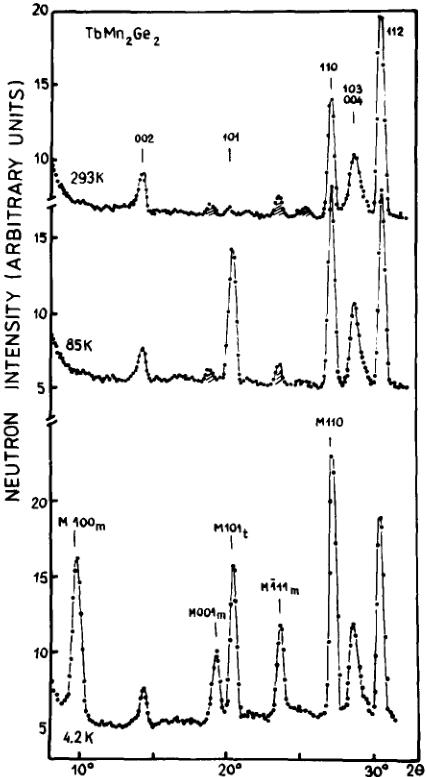
Neutron diffraction measurements were performed at the EWA reactor at the former Institute of Nuclear Research in Świerk. Neutron diffraction data \( (\lambda = 1.326 \times 10^{-1} \, \text{nm}) \) were collected by means of the DN-500 diffractometer at 293, 85 and 4.2 K (see Fig. 1). Additionally, the temperature dependence of magnetic peak heights was measured in the temperature range 4.2–293 K. The observed neutron intensities were treated with the line profile analysis method of Rietveld. Nuclear scattering lengths \( b_{Tb} = 0.76 \) , \( b_{Mn} = -0.39 \) and \( b_{Ge} = 0.819 \times 10^{-14} \, m \) [9] were used. The magnetic form factor for \( Tb^{3+} \) ion was taken after [10].
Room temperature diffractogram of \( TbMn_{2}Ge_{2} \) consists of strong reflections, satisfying the condition \( h + k + 1 = 2n \) , plus two superlattice lines, indexed as \( M111 \) and \( M113 \) .
The nuclear intensities were calculated using the following atomic positions:
Tb atoms in the positions 2(a): 0, 0, 0, \( \frac{1}{2} \) , \( \frac{1}{2} \) , \( \frac{1}{2}\frac{1}{2} \) in 4(d): \( \frac{1}{2} \) , 0, \( \frac{1}{4} \) , 0, \( \frac{1}{2} \) , \( \frac{3}{4} \) , 0, \( \frac{3}{4} \) , 0, \( \frac{1}{2} \) , (1 - e)Mn + eGe in 4(e): 0, 0, z, 0, 0, z, \( \frac{1}{2} \) , \( \frac{1}{4} \) , \( \frac{1}{2} \) + z, \( \frac{1}{2} \) , \( \frac{1}{\bar{2}} \) , \( \frac{1}{2} \) - z \( (1 - e)Ge + eMn \)
Table 1. Structural and magnetic parameters in TbMn_{2}Ge_{2}
| T(K) | 293 K | 85 K | 4.2 K |
| a(Å) | 4.006(2) | 4.006(4) | 3.972(3) |
| c(Å) | 10.875(6) | 10.842(8) | 10.758(8) |
| c(a) | 2.715 | 2.706 | 2.708 |
| V(Å3) | 174.52(27) | 174.00(47) | 169.73(44) |
| z | 0.3739(13) | 0.3744(14) | 0.3797(18) |
| μMn(μB) | 2.1(2) | 2.3(2) | 2.3(3) |
| μTb(μB) | - | 7.8(3) | 7.6(3) |
| RN(%) | 4.3 | 4.5 | 4.9 |
| RM(%) | 6.7 | 7.8 | 7.8 |
The minimum disagreement factor corresponded to the small mixing of Mn and Ge atoms between 4(d) and 4(e) positions (e = 0.02). The refined values of call constant and z parameter and corresponding minimum R factor are listed in Table 1.
The observed superlattice \( M_{1} \) 1 1 and \( M_{1} \) 1 3 lines are of magnetic origin. Similar magnetic reflections have been observed earlier in \( REMn_{2}Si_{2} \) (RE = Ce, Pr and Nd Nd), \( YMn_{2}Ge_{2} \) [1, 2] and \( ThMn_{2}Ge_{2} \) [11]. Thus a collinear antiferromagnetic ordering whose ferromagnetic layers composed of the Mn atoms make \( \pm-+\pm- \) sequence along the c-axis can be deduced persisting down to 4.2 K.
An increase of intensity of \( (101) \) , \( (110) \) and \( (103) \) peaks is observed on neutron diffraction pattern taken at 85 K, indicating the presence of a ferromagnetic ordering. The intensities analysis proved that parallel to the c-axis magnetic moments are localized on Tb atoms.
LHT neutron diffraction pattern contains additional reflections which were indexed on a monoclinic unit (m) cell obtained from the chemical one by the following transformation:
\[ \mathbf{a}_{m}=2\mathbf{a}_{t},\quad\mathbf{b}_{m}=\mathbf{a}_{t}+\mathbf{c}_{t},\quad\mathbf{c}_{m}=\mathbf{a}_{t}. \]
Its dimensions are thus:
\[ \begin{aligned}&a_{m}=7.944\ \textup{\AA},\quad b_{m}=11.468\ \textup{\AA}^{\prime},\quad c_{m}=3.972\ \textup{\AA},\\&\gamma=69.73^{\circ}.\\ \end{aligned} \]
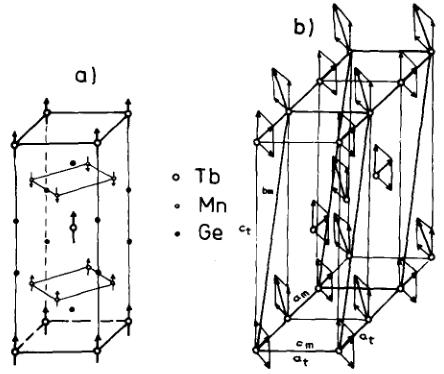
This unit cell is displayed in Fig. 1. Tb ions occupy the positions:
\[ S_{1}(0,0,0),\quad S_{2}(\frac{1}{2},0,0),\quad S_{3}(\frac{1}{2},\frac{1}{2}),\quad S_{4}(0,\frac{1}{2},\frac{1}{2}), \]
Group theory analysis [12] shows that in this magnet magnetic unit cell, the only magnetic modes are the components of the following vectors:
\[ F=S_{1}+S_{2}+S_{3}+S_{4},\qquad G=S_{1}-S_{2}+S_{3}-S_{4}. \]
\[ C=S_{1}+S_{2}-S_{3}-S_{4},\qquad A=S_{1}-S_{2}-S_{3}+S_{4}. \]
F mode is ferromagnetic, while the other are

Fig. 1. Neutron diffraction patterns of \( TbMn_{2}Ge_{2} \) at 4.2, 85 and 293 K. The reflections at 85 and 293 K are indexed in the tetragonal unit cell. The additional reflections at 4.2 K are indexed in the monoclinic unit cell (see Text). The shaded peaks arise from impurities.
antiferromagnetic. The additional reflections observed at 4.2 K are allowed only in the A magnetic mode.
Table 2. Bragg angles \( 2\theta_{B} \) and magnetic intensities I at T = 4.2 K for \( TbMn_{2}Ge_{2} \)
| hkl | 2θBobs | 2θBcalc | Iobs | Icalc | |
| Antiferromagnetic components | |||||
| 1 0 0 | 9.9 | 10.0 | 2921.4 | 2951.0 | |
| 1 2 0 | — | 14.4 | — | 0 | |
| 0 0 1 | 19.3 | 19.2 | 1185.7 | 1242.9 | |
| Γ 2 0 | 20.2 | 20.3 | 269.3 | 371.3 | |
| 1 1 1 | 21.8 | — | 0 | 178.7 | |
| Γ 1 1 | 23.8 | 24.0 | 1455.65 | 1038.3 | |
| 0 2 1 | 24.0 | 144.2 | |||
| 1 3 1 | — | 28.1 | 0 | 53.3 | |
| 3 2 0 | — | 29.2 | 0 | 15.7 | |
| R (%) | 9.2 | ||||
| Ferromagnetic components | |||||
| 0 2 0 | — | 14.4 | — | 0 | |
| 2 2 0 | 20.5 | 532.5 | |||
| 0 1 1 | 20.5 | 20.5 | 2942.9 | 815.5 | |
| 2 0 0 | 20.5 | 1621.7 | |||
| 2 1 1 | 27.3 | 27.3 | 960.0 | 951.5 | |
| 2 4 0 | 29.0 | 449.4 | |||
| 2 2 0 | 28.8 | 29.0 | 300.0 | 148.0 | |
| R (%) | 7.9 | ||||

Fig. 2. Magnetic structure of \( TbMn_{2}Ge_{2} \) : (a) tetragonal unit cell with the Tb and Mn sublattices at 85 K, (b) monoclinic unit cell with Tb sublattice at 4.2 K.
Their intensity analysis indicates, that the magnetic moment is parallel to the \( [1\ 2\ 0] \) direction. Its magnitude obtained in the course of least squares fit of observed and calculated integrated intensity amounts of \( 5.5 \pm 0.1 \) Bohr magnetons. The A-mode can be presented as a sequence of ferromagnetic (0 1 0) planes coupled antiferromagnetically.

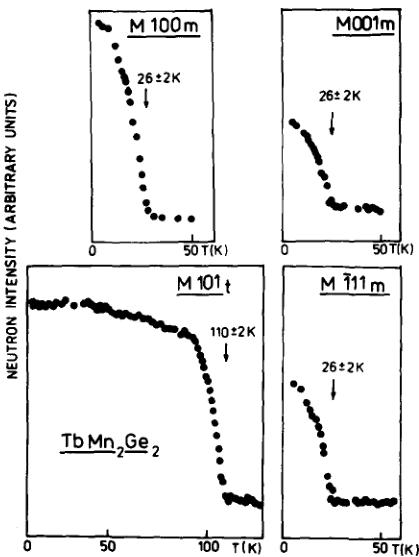
Fig. 3. Temperature dependence of height peaks of \( M1\ 00_{m} \) , \( M0\ 01_{m} \) , \( M\ \overline{1}\ 11_{m} \) and \( M1\ 01_{t} \) reflections.
The reflections corresponding to ferromagnetic component are also indexed in the monoclinic unit cell (see Fig. 1 and Table 2). The best fit of observed and calculated intensity amounts to \( 7.6 \pm 0.3 \) Bohr magnetons.
The total moment is however \( 9.1 \pm 0.3 \mu_{B} \) i.e. almost free ion value for \( Tb^{3+} \) ions.
Figure 3 shows the temperature vs. peak height curves of \( (M1\ 00)_{m} \) \( (M0\ 01)_{m} \) , \( (M\overline{1}\ 11)_{m} \) and \( (M1\ 01)_{t} \) reflections. Accordingly the monoclinic antiferromagnetic structure transforms at \( 26\pm2 \) K into a tetragonal ferromagnetic structure which is stable up to the Curie point at \( 110\pm2 \) K.
3. SUMMARY
Our results indicate an interesting magnetic behaviour of \( TbMn_{2}Ge_{2} \) :
(1) In the temperature range between 4.2 K and \( T_{N}=413 \) K magnetic moments localized on Mn ions are ordered antiferromagnetically. The collinear magnetic structure consists of ferromagnetic layers stacked along the c-axis of a tetragonal unit cell with the sequence + - + -. Moments are pointing along the c-axis.
(2) Below \( T_{c}=110 \) K collinear ferromagnetic ordering of Tb moments along the c-axis is observed.
(3) At \( T_{t}=26 \) K terbium magnetic sublattice transforms into an antiferromagnetic one. Magnetic moments have two components:
(a) ferromagnetic, which is parallel to the c-axis of a tetragonal unit cell, and (b) antiferromagnetic, parallel to the [1 2 0] direction in monoclinic unit cell.
Finally it is interesting to mention that \( TbMn_{2}Si_{2} \) exhibits a complex, helicoidal type magnetic ordering of Tb moments persisting up to 56 K, apart from collinear antiferromagnetic order of Mn moments of \( +-+- \) type, stable up to 501 K [13].
REFERENCES
-
S. Siek, A. Szytuła & J. Leciejewicz, Phys. Status Solidi (a) 46, K101 (1978).
-
S. Siek, A. Szytuła & J. Leciejewicz, Solid State Commun. 39, 863 (1981).
-
J. Leciejewicz, S. Siek & A. Szytuła (unpublished).
-
Z. Ban & M. Sikirica, Acta Cryst. 18, 594 (1965).
-
K.S.V.L. Narasimhan, V.U.S. Rao, R.L. Bergner & W.E. Wallace, J. Appl. Phys. 64, 4597 (1976).
-
K.S.V.L. Narasimhan, V.U.S. Rao, W.E. Wallace & I. Pop, AIP Conf. Proc. 29, 594 (1975).
-
A. Szytuła & I. Szott, Solid State Commun. 40, 199 (1981).
-
T. Shigeoka, H. Fujii, H. Fujiwara, K. Yagasaki & T. Okamoto, J. Magn. Magn. Mater. 31–34, 209 (1983).
-
G.E. Bacon, Acta Cryst. A28, 357 (1972).
-
O. Steinsvoll, C. Shirane, R. Nathans, M. Blume, H. Alperin & S.J. Pickart, Phys. Rev. 161, 1499 (1967).
-
Z. Ban, L. Omeejc, A. Szytuła & Z. Tomkowicz, Phys. Status Solidi (a) 27, 333 (1973).
-
E.F. Bertaut, Acta Cryst. A24, 217 (1968).
-
S. Siek, A. Szytuła & J. Leciejewicz (unpublished).
 p2_0.jpg
 p3_0.jpg
 p3_1.jpg