| Transition Temperature | 90(10) K |
|---|---|
| Experiment Temperature | 1.6 K |
| Propagation Vector | k1 (0, 0, 0) |
| Parent Space Group | Pbnm (#62) |
| Magnetic Space Group | Pn'm'a (#62.446) |
| Magnetic Point Group | m'm'm (8.4.27) |
| Lattice Parameters | 5.25100 5.57600 7.58400 90.00 90.00 90.00 |
|---|---|
| DOI | 10.1016/0038-1098(68)90327-X |
| Reference | J.A. Leake, G. Shirane, J., P., Remeika, Solid State Communications (1968) 6 15 - 17 |
| Label | Element | Mx | My | Mz | |M| |
|---|---|---|---|---|---|
| Tm1 | Tm | 0.0 | 0.0 | 0.0 | 0.00 |
| Fe1 | Fe | 0.0 | 0.0 | 1. | 1.00 |
THE MAGNETIC STRUCTURE OF THULIUM ORTHOFERRITE, TmFeO_{3}
J. A. Leake \( ^{†} \) and G. Shirane
Brookhaven National Laboratory, Upton, New York, U.S.A. and
J. P. Remeika
Bell Telephone Laboratories, Murray Hill, New Jersey
(Received 9 November 1967 by B.N. Brockhouse)
The magnetic structure of the orthorhombic perovskite \( TmFeO_{3} \) has been studied between 1.6°K and room temperature by neutron diffraction measurements on powdered material. Above 94°K the iron moments are ordered in a G-type antiferromagnetic arrangement parallel to \( \{100\} \) with a slight cant producing a weak ferromagnetic component along [001]. Reorientation occurs between 94° and 81.5°K, below which the antiferromagnetic component is along [001]. No ordering of the thulium moments is observed down to 1.6°K.
THULIUM ORTHOFERRITE is a member of the series of rare-earth-iron perovskites, other examples of which have already been investigated. \( ^{1} \) With the conventional labelling the unit cell dimensions are \( ^{3} \) a = 5.251 Å, b = 5.576 Å and c = 7.584 Å and the space group is Pbnm. The a and b axes correspond to (001) face-diagonals of the cubic unit cell of the ideal perovskite structure while the c-axis is double that of the cubic cell. A refinement of the positional parameters of the thulium and oxygen ions has not yet been completed but a comparison of the approximate intensities of the X-ray powder diffraction lines of \( TmFeO_{3} \) and \( TbFeO_{3} \) shows no reason for expecting significant differences from the parameters found for \( TbFeO_{3} \) . The co-ordination polyhedron of oxygen ions around an iron ion is an almost regular octahedron while that around a thulium ion is a slightly distorted square prism. The neutron diffraction pattern from a cylindrical sample of powdered \( TmFeO_{3} \) , 9 mm diameter and 35 mm long, was recorded at the Brookhaven High Flux Beam Reactor at temperatures of 1.6, 4.5, 78.4, 170, and 295°K. At the two lowest temperatures the range of measurements was 0.025 ( \( \sin \varepsilon \) )/ \( \lambda \) ≤ 0.29 Å \( ^{-1} \) while for the higher temperatures it was extended to ( \( \sin \varepsilon \) )/ \( \lambda \) = 0.41 Å \( ^{-1} \) . In addition the 011 and 101 peaks were measured at 83.4, 88.4 and 93.4°K. The wavelength of the neutron beam used was 1.034 Å.
An inspection of the diffraction data showed that all the powder lines could be indexed on the assumption that the dimensions of the crystallographic and magnetic unit cells were identical. Several magnetic peaks occurred at positions where the nuclear structure factors were either systematically zero because of the symmetry or else were very small. The indices of these peaks were all of the form \( h + k \) odd, \( \ell \) odd. The most prominent were 011 and 101 for which \( (\sin \varepsilon)/\lambda \approx 0.11 \mathring{\mathrm{A}}^{-1} \) .
Following the system of notation used
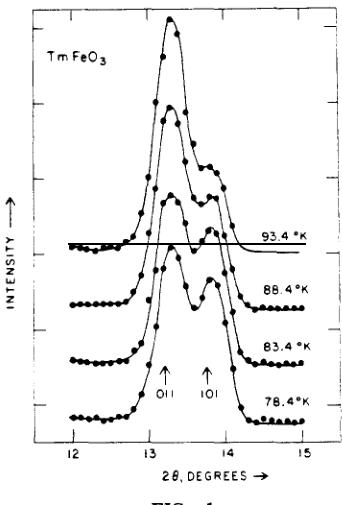
by Bertaut \( ^{4} \) for describing the magnetic structures of orthorhombic perovskites our results may be interpreted as follows. Since, at all the temperatures used, the magnetic reflections had indices of the form \( h + k \) odd, \( \lambda \) odd the moments on the iron ions must always be ordered in a G-type arrangement, in which the moments of the six nearest neighbours of any given iron ion are aligned antiparallel to the moment of that ion. An inspection of the intensities of the magnetic peaks shows that above \( 94^{\circ}K \) the antiferromagnetic moments lie close to \( [100] \) . This corresponds to the \( \Gamma_{4} \) representation of Bertaut, \( ^{4} \) in which a ferromagnetic moment parallel to \( [001] \) is permitted. A weak ferromagnetic moment, about \( 0.1 \mu_{B} \) per iron ion, in this direction has been reported, \( ^{6} \) Symmetry arguments show that there should be no component of magnetic moment along \( [010] \) . On cooling, the antiferromagnetic moment direction changes from \( [100] \) to \( [001] \) . This reorientation is common in this class of material. \( ^{7} \) The present results are in agreement with the magnetisation data \( ^{8} \) which showed that in \( TmFeO_{3} \) the reorientation takes place over the temperature range 94 - 81.5°K. The variation in intensity of the 011 and 101 peaks during the reorientation process is shown in Fig. 1. Below 81.5°K the ferromagnetic moment along \( [100] \) is about 0.05 \( \mu_{B} \) per iron ion. \( ^{6} \) The neutron data do not provide sufficient information to determine whether the reorientation takes place smoothly or the high and low temperature structures co-exist within the transition region.
The powder diffraction patterns recorded at 1.6 and 4.5°K were essentially the same as that obtained at 78.4°K. At all temperatures the angular variation of the strong background was characteristic of paramagnetic scattering, due to the unaligned thulium moments. The absence of any additional magnetic peaks or significant changes in the intensities of existing peaks also show that the thulium ions do not become magnetically ordered down to 1.6°K. A study of the temperature at which ordering of the rare-earth ion first occurs in other rare-earth-iron orthoferrites (Tb 8.4°K, 2 Ho 6.5°K, and Er 4.3°K) shows a rapid decrease with increasing atomic number so that the absence of

FIG. 1
The 011 and 101 reflections of \( TmFeO_{3} \) at several temperatures in the transition region. The 011 reflection is purely magnetic. The nuclear contribution to the intensities of 101 does not exceed 0.5 per cent of the total.
ordering in \( TmFeO_{3} \) may not be surprising. The difference between these results and the magnetisation data, which suggested some ordering of the thulium moments, may be due to the fact that our measurements were performed without the application of an external magnetic field.
Acknowledgment - We are indebted to E.M. Gyorgy for suggestions and close interest in this work. We are also grateful to E.I. Blount and D.E. Cox for helpful discussions and E.M. Kelly for assistance in the preparation of the specimens.
References
-
KOEHLER W.C., WOLLAN E.O. and WILKINSON M.K., Phys. Rev. 118, 58 (1960).
-
BERTAUT E.F., CHAPPERT J., MARESCHAL J., REBOUILLAT J.P. and SIVARDIERE J., Solid State Commun. 5, 293 (1967).
-
EIBSCHUTZ M., Acta Crystallogr. 19, 337 (1965).
-
BERTAUT E.F., Magnetism, Vol. III (RADO G.T. and SUHL H. eds.) Academic Press, New York (1963).
-
BERTAUT E.F. and MARESCHAL J., Solid State Commun. 5, 93 (1967).
-
GYORGY E.M., REMEIKA J.P. and HAGEDORN F.B., J. appl. Phys. (in press).
-
SHERWOOD R.C., VAN UITERT L.G., WOLFE R. and LECRAW R.C., Phys. Lett. 25A, (1967).
-
WOLFE R., PIERCE R.D., HASZKO S.E. and REMEIKA J.P., Appl. Phys. Lett. (in press).
Магнитная структура ортосромнческого перовскита ТмFeO₃ била исследована между I.₆⁶K и комнатной темпера- туро⁸ способом нейтронного графических измерений на пудровом материале. Тыше 94⁶K железные моменты упрёдсченны в G- типсовом антигероэмагнитном расположении параллельным к [ICO¹ с необходим наклоном устанавливающим слабы⁷ ферро- магнитных) компонент по [COI]. Ресриентация происходит между 94⁶K и E.I.⁶⁶K, ниже которого антигеромагнитный компонент идет по [COI]. Упрядсчение тулиевых компон- онте не наблюдается вглоть дс I.⁶⁶K.
 p2_0.jpg