| Transition Temperature | 640 K |
|---|---|
| Experiment Temperature | 8 K |
| Propagation Vector | k1 (0, 0, 0) |
| Parent Space Group | Pnma (#62) |
| Magnetic Space Group | Pn'ma' (#62.448) |
| Magnetic Point Group | m'm'm (8.4.27) |
| Lattice Parameters | 5.48600 5.59100 7.78300 90.00 90.00 90.00 |
|---|---|
| DOI | 10.1016/0022-5088(85)90175-4 |
| Reference | I Sosnowska, P Fischer, Journal of the Less-Common Metals (1985) 111 109 - 111 |
| Label | Element | Mx | My | Mz | |M| |
|---|---|---|---|---|---|
| Fe1 | Fe | 4.14 | 0.0 | 0.0 | 4.14 |
REFINEMENT OF THE CRYSTAL AND MAGNETIC STRUCTURE OF \( PrFeO_{3} \) AT T = 8 K \( ^{*} \)
I. SOSNOWSKA
Institute of Experimental Physics, University of Warsaw, Warsaw (Poland)
P. FISCHER
Laboratorium für Neutronenstreuung, ETH, CH-5303 Würenlingen (Switzerland)
(Received December 8, 1984)
Summary
The orthoferrite \( PrFeO_{3} \) crystallizes according to space group \( Pbnm \) , and the magnetic structure is of the \( G_{x} \) type. Based on neutron-diffraction measurements performed at 8 K with improved resolution, the structure parameters and the ordered magnetic moment of \( Fe^{3+} \) ( \( \mu = \mu_{x} = 4.14(4)\mu_{B} \) ) were refined. The results are compared with previous room-temperature data.
1. Introduction
The crystal structures of rare earth orthoferrites were extensively investigated at room temperature by Marezio et al. employing single-crystal X-ray studies \( [1] \) . Neutron-diffraction measurements of the 011 and 101 reflections of \( PrFeO_{3} \) , performed by Pinto and Shaked \( [2] \) , indicate \( G_{x} \) -type antiferromagnetic ordering of \( Fe^{3+} \) moments in the temperature range 4.2 - 293 K. The time-of-flight (TOF) neutron-diffraction study reported by Kaun et al. \( [3] \) supports this model in the temperature range 77 - 293 K. In a previous neutron-diffraction study of \( PrFeO_{3} \) made at room temperature by the authors \( [4] \) the ordered magnetic moment \( \mu = \mu_{x} = 3.73(3)\mu_{B} \) per \( Fe^{3+} \) ion was determined, and the orthorhombic crystal structure corresponding to space group \( Pbnm \) \( [1] \) was confirmed. By means of high-resolution TOF neutron data Sosnowska and Steichele \( [5] \) proved that the magnetic structure of \( PrFeO_{3} \) is of pure \( G_{x} \) type at room temperature. The present experiment extends the quantitative analysis of the crystal and magnetic structures of \( PrFeO_{3} \) to low temperatures (8 K).
2. Experimental details and discussion
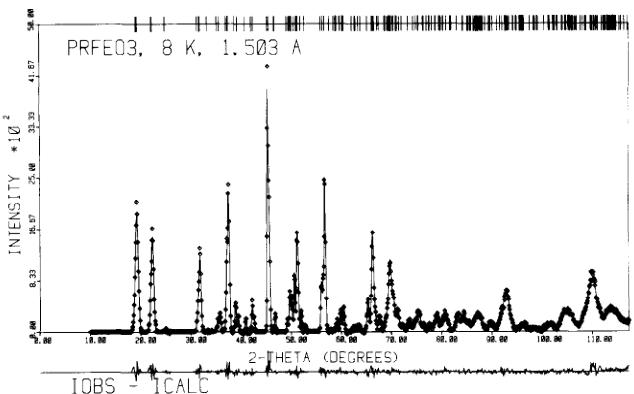
Using improved resolution (neutron wavelength, \( \lambda = 1.503 \AA \) , from a Ge 311 monochromator and collimations \( \alpha_{1} = \alpha_{3} = 10' \) ) compared with the 293 K study [4], the neutron-diffraction measurement was performed on a polycrystalline sample of \( PrFeO_{3} \) on a two-axis spectrometer situated at the Saphir reactor, Würenlingen. Figure 1 shows the corresponding 8 K diffraction pattern. The neutron intensities were analysed by the Rietveld profile method [6] using the neutron scattering lengths \( b_{Pr} = 4.45 \) , \( b_{Fe} = 9.54 \) , \( b_{O} = 5.81 \) F and the neutron magnetic form factor of \( Fe^{3+} \) [7]. Good agreement of observed and calculated neutron intensities was achieved. The relevant results are summarized in Table 1. The 8 K and room-temperature structures appear to be similar. Also at 8 K, the magnetic structure is of the \( G_{x} \) type, and the ordered magnetic moment, \( \mu_{Fe} \) , amounts to \( 4.14(4)\mu_{B} \) , i.e., it is reduced below the free-ion value of \( 5\mu_{B} \) (S = 5/2). These results support ref. 2 as well as the estimate of a weak Pr–Fe coupling in \( PrFeO_{3} \) published by Pataud and Sivardière [8], which makes reorientation phase transitions improbable.
TABLE 1
Parameters of the crystal and magnetic structure of \( PrFeO_{3} \) for space group \( Pbnm \) , determined by means of neutron diffraction
| T (K) | 8 | 293 [4] | 293 [1] |
| \( \lambda \) ( \( \textup{\AA} \) ) | 1.503(1) | 2.331(2) | X-rays |
| a ( \( \textup{\AA} \) ) | 5.486(4) | 5.483(5) | 5.482 |
| b ( \( \textup{\AA} \) ) | 5.591(4) | 5.578(5) | 5.578 |
| c ( \( \textup{\AA} \) ) | 7.783(5) | 7.788(7) | 7.786 |
| \( B_{\textup{Pr}} \) ( \( \textup{\AA}^{2} \) ) | 0.5(1) | 0.92(5) | |
| \( B_{\textup{Fe}} \) ( \( \textup{\AA}^{2} \) ) | 0.22(4) | 0.92(5) | |
| \( B_{\textsf{O}} \) ( \( \textup{\AA}^{2} \) ) | 0.41(4) | 0.92(5) | |
| \( x_{\textup{Pr}} \) | 0.990(2) | 0.984(2) | 0.99097(4) |
| \( y_{\textup{Pr}} \) | 0.0450(9) | 0.044(1) | 0.04367(5) |
| \( x_{\textsf{O1}} \) | 0.086(1) | 0.084(1) | 0.0817(7) |
| \( y_{\textsf{O1}} \) | 0.4795(9) | 0.481(1) | 0.4788(9) |
| \( x_{\textsf{O2}} \) | 0.7076(6) | 0.7065(7) | 0.7075(5) |
| \( y_{\textsf{O2}} \) | 0.2925(6) | 0.2908(6) | 0.2919(5) |
| \( z_{\textsf{O2}} \) | 0.0448(5) | 0.0449(6) | 0.0437(5) |
| \( \mu_{\textup{Fe}} \) ( \( \mu_{\textup{B}} \) ) | 4.14(4) | 3.73(3) | |
| \( R_{\textup{wp}} \) | 0.121 | 0.091 | |
| \( R_{\textup{in}} \) | 0.046 | 0.034 | 0.023 |
| \( R_{\textup{im}} \) | 0.033 | 0.017 | |
| \( R_{\textup{e}} \) | 0.071 | 0.058 |
T = temperature, \( \lambda \) = neutron wavelength, a, b, c = lattice constants, B = temperature factor, \( R_{wp} \) , \( R_{in} \) , \( R_{im} \) = agreement ratios concerning weighted profile and integrated nuclear and magnetic intensities, respectively, \( R_{e} \) = statistically expected R factor [6], \( \mu \) = ordered magnetic moment per \( Fe^{3+} \) ion. Literature data for the room-temperature structure are added for comparison.

Fig. 1. Observed (points, corrected for absorption and background) and calculated (line) neutron diffraction patterns of \( PrFeO_{3} \) at 8 K (step \( \Delta2\theta = 0.1^{\circ} \) ).
Acknowledgments
One of the authors (I.S.) was supported by research grant MR.I.5 and the ETH neutron scattering laboratory.
References
1 M. Marezio, J. P. Remeika and P. D. Dernier, Acta Crystallogr., Sect. B, 26 (1970) 2008.
2 H. Pinto and H. Shaked, Solid State Commun., 10 (1972) 663.
3 J. L. P. Kaun, B. Lilppold, M. M. Lukina, W. Matz, B. N. Savenko and K. Henning, Sov. Phys. Crystallogr., 21 (1976) 212.
4 I. Sosnowska and P. Fischer, AIP Conf. Proc., 89 (1982) 346.
5 I. Sosnowska and E. Steichele, AIP Conf. Proc., 89 (1982) 309.
6 H. M. Rietveld, J. Appl. Crystallogr., 2 (1969) 65.
7 R. E. Watson and A. J. Freeman, Acta Crystallogr., 14 (1961) 27.
8 P. Pataud and J. Sivardière, J. Phys. (Paris), 31 (1970) 1017.
 p3_0.jpg